What a week for tech news. Between a coordinated industry warning about AI-powered cyberattacks, a massive breach at three UK airports, new tariff threats on the chips powering everything, and Google breaking ground on a billion-dollar data center right here in Malaysia — there is plenty to unpack. Here are the six stories that mattered this week.
1. 🛡️ OpenAI, Google and 100+ Firms: The "Limited Window" to Defend Against AI Cyberattacks
In the biggest coordinated statement of its kind, OpenAI, Anthropic, Google, Microsoft and more than 100 other technology companies publicly called for urgent action to defend against AI-powered cyberattacks. The group warned that there is a "limited window" to prepare defensive systems before AI-driven attacks become a mainstream threat against critical infrastructure.
The joint statement, covered by BBC, The New York Times, TechCrunch and Politico, argues that AI is making offensive cyber operations cheaper, faster, and more scalable — and that defensive tooling is not keeping pace. The companies are pushing for cyber defense to be treated as a leadership priority, not an afterthought, and for governments to step up coordinated action.
Why this matters: This is not a niche security vendor shouting about threats — this is the entire AI industry, including the very companies building the models, saying the same thing at once. When OpenAI, Anthropic, Google and Microsoft align on a warning, enterprise IT teams should treat it as a signal to review their own defensive posture. If AI-powered attacks are coming, the "limited window" applies to everyone — not just hyperscalers.
2. ✈️ Cyber Attack on UK Airports Exposes Data of 8.7 Million Customers
Manchester Airports Group (MAG), which operates Manchester, London Stansted and East Midlands airports, confirmed that hackers accessed the personal data of approximately 8.7 million customers. The breach, first reported on August 27, is one of the largest aviation-sector attacks in recent memory.
According to the BBC, Financial Times and Sky News, the compromised data includes customer names, contact details and — for some passengers — booking and travel information. MAG said it is contacting affected customers and working with the National Cyber Security Centre and law enforcement. The attackers reportedly used credentials from a third-party supplier to access the data.
Why this matters: Aviation is high-value, high-stakes infrastructure, and this breach shows that even well-run airport groups are only as secure as their weakest supplier link. The "third-party supplier" angle is a familiar theme: supply-chain attacks remain one of the most effective ways into large organizations. For IT teams, it is a reminder that vendor risk management and least-privilege access are not just compliance checkbox items.
3. 💻 Trump Administration Weighs Expanding Chip Tariffs to Laptops, Servers and Consoles
The AI industry's favorite hardware is back in the tariff crosshairs. Reports from Politico, Ars Technica and Tom's Hardware say the Trump administration is considering a new round of semiconductor tariffs that would extend to laptops, consoles, servers and data center equipment — not just the chips themselves.
Ars Technica quotes AI industry executives describing the plan as the "single dumbest way imaginable" to tax chips, pointing out that tariffs on servers and networking gear would raise the cost of the very AI buildout the administration has championed. Politico frames it as a direct conflict between tariff policy and the push for American AI dominance, with data center operators warning of higher costs and delayed expansions.
Why this matters: If you run infrastructure — or budget for it — this story matters twice over. First, tariffs on servers and laptops mean hardware price increases ripple through every IT procurement cycle. Second, the uncertainty itself is costly: companies delay data center expansions and capacity planning when the cost of gear is a moving target. Watch this one closely in the coming weeks.
4. 🇲🇾 Google Breaks Ground on US$2 Billion Data Center and Cloud Region in Malaysia
Great news for the local tech scene: Google officially broke ground on its US$2 billion data center and cloud region in Malaysia, with the campus located in Selangor. The company announced the milestone alongside new commitments on sustainability, and the project is a cornerstone of Malaysia's push to become Southeast Asia's AI and data center hub.
The news lands alongside a wave of regional momentum: Japan Wire (Kyodo) reported that Malaysia is actively courting AI-driven data center investments, TechRepublic noted that Johor's data center capacity is tightening as demand surges, and analysts project Southeast Asia data center investment reaching US$35 billion by 2031. The Edge Malaysia also reported the tech sector is poised for an extended AI-driven bull run into FY27.
Why this matters: For Malaysian IT professionals, this is more than a ribbon-cutting story. A US$2 billion cloud region means local jobs, lower-latency access to Google Cloud services, and a stronger ecosystem for local startups and enterprises. It also signals that the country's bet on becoming a regional digital infrastructure hub is paying off — with all the downstream demand that creates for network engineers, sysadmins and cloud specialists.
5. 🚀 Nvidia Revenue Tops $96 Billion as Data Center Demand Keeps Soaring
Nvidia reported its second-quarter fiscal 2027 results this week, and the numbers are staggering: revenue topped $96 billion, roughly double year-over-year, powered by Blackwell Ultra GPUs and relentless data center demand. The Austin American-Statesman reported the company is expanding operations in Austin, and Axios noted Nvidia projects about 70% revenue growth continuing into 2028.
The company's CFO also highlighted that around half of its data center business now comes from customers beyond the big hyperscalers — enterprises, sovereign AI projects and cloud startups — signaling that AI compute demand has broadened far beyond the usual suspects.
Why this matters: Nvidia's earnings are the canary in the coal mine for the entire AI infrastructure economy. When revenue doubles and growth is projected to continue, it tells you that AI adoption is still accelerating, not cooling off. For anyone planning capacity, skills or careers around AI infrastructure, this is the strongest possible signal that the buildout is nowhere near finished.
6. ⚠️ Bill Gates Warns AI Is More Dangerous Than Big Tech Will Admit
Microsoft co-founder Bill Gates used the release of a new essay to deliver his starkest AI warning yet: artificial intelligence, he argues, is more dangerous than big tech companies are willing to admit, and he is proposing major limits on AI development. The New York Times and CNN covered the remarks, with Gates calling the current moment "the turbulent AI era" and saying "the choices we make now are critical."
Gates' proposal reportedly centers on slowing down the most powerful frontier model development and building stronger safety and alignment mechanisms before deployment — a notable stance from someone who has historically been an AI optimist.
Why this matters: When one of the most prominent technology figures in history — someone with a direct line to Microsoft and OpenAI — publicly argues for limiting AI development, it shifts the conversation. It adds weight to the growing regulatory push around frontier AI, and it tells enterprises that "AI safety" is moving from a niche concern to a mainstream boardroom topic. Expect this debate to intensify through the rest of the year.
By the Numbers: The Week in Tech
- 8.7 million — airport customer records exposed in the MAG breach across three UK airports.
- $96 billion+ — Nvidia's quarterly revenue, roughly double year-over-year, with ~70% growth still projected.
- $2 billion — Google's investment in its new Malaysian data center and cloud region in Selangor.
- 100+ — tech companies, including OpenAI, Google, Anthropic and Microsoft, that signed the AI cyber defense call.
- $35 billion — projected Southeast Asia data center investment by 2031, per industry analysts.
Wrapping Up
This week's theme is clear: AI is growing faster than the systems that protect, regulate and house it. The industry is warning about AI-powered attacks, governments are debating tariffs on the hardware AI runs on, and Malaysia is positioning itself right in the middle of the data center boom. Whether you are a sysadmin watching hardware costs, a security professional tracking the breach wave, or a tech enthusiast following the AI race — there is plenty to keep an eye on next week. Stay tuned for the next edition of the IT Weekly Roundup.
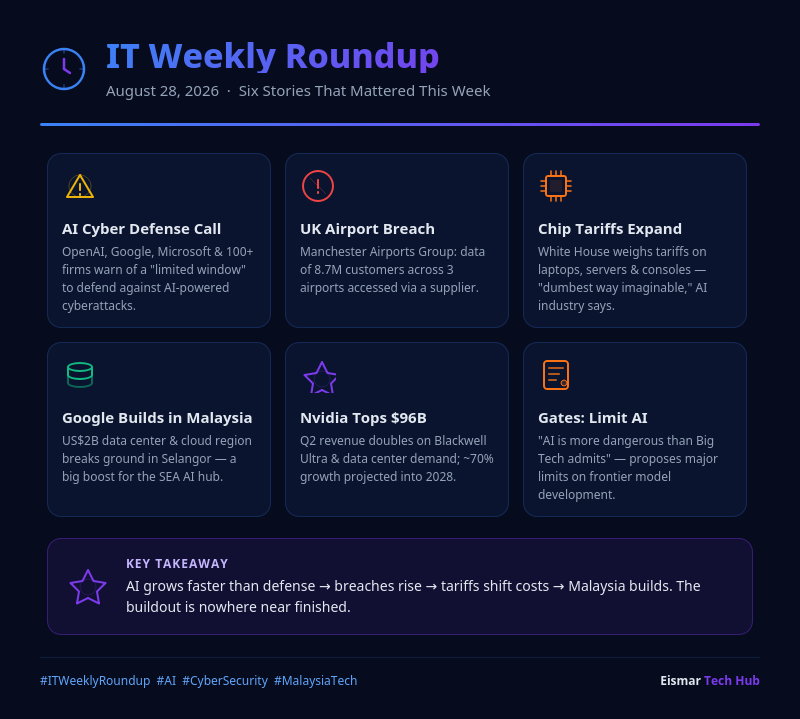
Infographic: IT Weekly Roundup Aug 28

💬 0 Comments