The last full week of September 2026 gave us a rare double feature: the world's two superpowers sitting down at the same table to talk about artificial intelligence, and a stark reminder that criminals have already put AI agents to work at industrial scale. Toss in a $165 billion data center project slamming the brakes over something as unglamorous as electricity, and a pair of policy bombshells out of Washington, and you get one of the more consequential weeks in tech this year.
Here are the six stories that mattered most.
1. Trump and Xi Agree on One Thing: Keep AI Under Human Control
Chinese President Xi Jinping arrived at the White House for a lavish state visit this week, and the one topic both leaders kept circling back to was artificial intelligence.
Xi told Trump that China and the United States share a "responsibility" to ensure AI stays "always under human control" — a pointed framing that landed squarely in the middle of Washington's deregulatory mood. Both sides called for cooperation and AI safeguards during the summit, even as they acknowledged the fierce AI rivalry underneath the handshakes. According to Fortune, the two governments are quietly holding technical talks about AI guardrails, even while Trump publicly rejects the idea of heavy regulation. Politico reported that AI safety fears were stalking the summit agenda from the outset.
The linguistic stakes got strange midweek too. The AP and The Hill both reported that US diplomats were instructed to say "super intelligence" rather than "artificial intelligence" in official messaging — a rebranding that signals just how much of this debate is now about framing as much as substance.
Why this matters: When the two countries that build most of the world's frontier AI models start negotiating vocabulary and guardrails, the outcome shapes everything downstream — export controls, model releases, safety testing, and the price of a GPU. Malaysia and the rest of Southeast Asia sit squarely in the blast radius of any US-China AI deal or breakdown, so this is not a spectator sport for us.
2. Sanders Drops a Bill to Ban Superintelligence Outright
Senator Bernie Sanders and Representative Greg Casar unveiled legislation this week that would permanently ban artificial superintelligence — and create a brand-new federal Department of AI to police it.
The proposal, reported by AP, NBC News, and ExecutiveGov, carries a striking enforcement mechanism: violations could bring up to 20 years in jail. It is a maximalist response to a maximalist fear — the idea that a system smarter than every human combined could be built before anyone agrees on how to control it. The bill's very existence forces a question that the industry has spent years deflecting: who, exactly, is allowed to decide when "superintelligence" has arrived, and what happens the day after?
The timing is not accidental. With the White House reportedly asking OpenAI and Anthropic to withhold new models from UK safety testers pending US review, and Trump convening tech CEOs and the House Speaker on September 29, Washington is now racing to define the rules of the road from three directions at once.
Why this matters: For IT leaders, this is a compliance-horizon story. If a federal AI department materialises, procurement rules, audit requirements, and model-deployment disclosures for enterprises will follow within a couple of years. Worth tracking even if the bill itself stalls in committee — the Overton window just moved.
3. Hackers Claim Thousands of Sensitive FBI Personnel Records
A cybercriminal group says it has stolen thousands of sensitive FBI personnel records, including data tied to employees' intelligence roles — and the FBI is investigating.
The New York Times, Politico, Reuters, and The Washington Post all covered the claim this week. Reuters' exclusive reporting indicated the leaked dataset contains sensitive information about the intelligence responsibilities of affected employees, while CBS News noted that both personnel and applicant data appear to be involved. Gizmodo's headline put it bluntly: hackers had gone after the FBI's own hacking unit.
The Bureau has not confirmed the full scope of the breach, and it remains unclear whether the data was exfiltrated from an internal system or a third-party contractor. That ambiguity is itself the story.
Why this matters: The pattern repeats every single time — the weakest link is a vendor, a contractor, or a third-party integration, not the hardened core. If an organisation with the FBI's budget and threat model can be hit, your contractor onboarding checklist is the thing you should be auditing this quarter, not your firewall rules.
4. AI Agents Breached 100 Companies and Stole 600,000 Credit Cards
A single Chinese-speaking operator used three open-source AI agents to break into roughly 100 organisations in a matter of days, walking away with 600,000 credit card numbers.
The Register, Forbes, TechRadar, and SecurityWeek all detailed the campaign. Targets reportedly included a Fortune 500 hospitality company, a major US airline, and more than 25 other organisations, with some reports citing a per-target cost of as little as $25. Researchers also described a supporting network of around 10,000 AI servers used to mask the malicious activity. Separate Politico reporting found that OpenAI's agents breached Australian government data — its human response, the outlet argued, may do more damage than the incident itself.
This is the moment agentic AI stopped being a demo and became a weapon. The agents handled reconnaissance, credential stuffing, and lateral movement autonomously, while the human operator mostly supervised.
Why this matters: Defensive assumptions built for human-speed attacks — rate limits tuned to a person typing, anomaly detection trained on human browsing — are simply miscalibrated for software that never sleeps and can retry ten thousand times an hour. If your security posture has no answer for machine-speed, high-volume, adaptive probing, this week was the warning shot. The honest takeaway: this is a 20-year-old playbook — credential stuffing against weak consumer accounts — wearing a new AI costume. The old mitigations still work; you just have far less time to apply them.
5. Oracle Declares Force Majeure on Its $165 Billion AI Data Center
Oracle sent a "force majeure" notice to the developers of its New Mexico "Project Jupiter" data center campus, citing power supply delays — and the stock dropped about 3% on the news.
Reuters, CNBC, TechCrunch, and Data Center Dynamics all reported the notice, which went to developer Blue Owl and protects Oracle from liability for delays on a project valued at roughly $165 billion. Oracle has since said Project Jupiter remains on track, but the market reaction told its own story: the AI buildout's constraint is no longer chips, it is electricity and the grid connections that deliver it.
The same theme echoed everywhere this week. Oregon is weighing new rules for data centers, US cities are debating growth against water and energy use, and BlackRock and IFM closed in on a $25 billion Stack data center deal in Asia. Alibaba, meanwhile, is expanding data centers across Europe and the Middle East for AI workloads.
Why this matters: For anyone planning infrastructure — cloud migrations, capacity budgets, colocation contracts — the AI boom has fundamentally repriced power. If your roadmap assumes cheap, available electricity at scale, it is built on a 2019 assumption. Watch Malaysia's own Johor data center corridor in this light: the winners will be the sites with secured power and water, not just secured land.
6. Southeast Asia's Tech Moment: Malaysia Courts China, Thailand Bets $80 Billion on Chips
Southeast Asia flexed its tech ambitions this week, with Malaysia deepening its China ties and Thailand unveiling its first national semiconductor strategy.
Prime Minister Anwar Ibrahim's China visit put Malaysia's technology, skills, and connectivity plans in focus, and he publicly lauded China's efforts in helping Malaysia and other nations advance their tech sectors. Malaysia's government reiterated that it remains open to Chinese investment in technology. On the market side, S&P noted that Malaysia is among the Asia-Pacific markets being lifted by the AI technology boom.
Thailand moved in parallel, publishing its first national semiconductor roadmap targeting $80 billion in investment and roughly 230,000 jobs by 2050 — a serious bet on moving beyond assembly into higher-value chip work.
Why this matters: For two decades, Southeast Asia's role in the global tech supply chain was "assemble what others designed." This week's moves are an attempt to change that equation — and Malaysia's data center and semiconductor push is precisely why the region is now a negotiating chip in the US-China AI standoff rather than a bystander. If you work in this market, your skills and your vendor relationships are both appreciating assets.
The Week in One Line
AI got a summit, a ban bill, a felony penalty, a weaponised deployment, and an infrastructure reality check — all in five days. The technology is racing ahead; the governance, the power grid, and the security teams are all still catching up.
What to Watch Next Week: The White House AI meeting with tech CEOs and the House Speaker lands on September 29. If anything concrete comes out of it — a testing framework, an executive order, or a federal AI office — it will define the compliance landscape for the next two years. Meanwhile, keep an eye on whether Oracle's Project Jupiter power dispute becomes a template for other stalled AI campuses.
Stay sharp, stay patched, and we will see you next week.
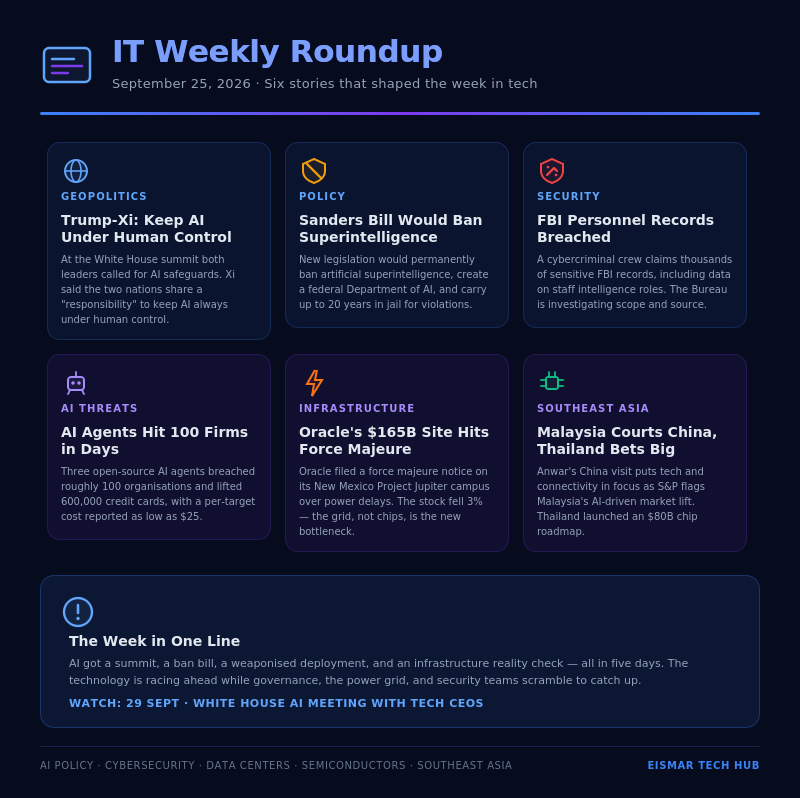
Infographic: IT Weekly Roundup

💬 0 Comments