It has been a week where the biggest stories weren't about flashy gadgets — they were about control. Control of networks, control of AI, and control of the chip supply chain. A US telecom giant literally cut a cable with scissors to evict state-backed hackers. Washington finally put pen to paper on an AI oversight framework after summoning the industry's biggest labs. Alibaba switched on a data center running entirely on homegrown Chinese silicon. And closer to home, Malaysia's Prime Minister spent the week courting Japanese investment in AI and quantum computing — while warning that the technology must not become a tool of "digital colonisation." Here are the six stories that defined August 14–21, 2026.
1. T-Mobile's Security Team Literally Cut a Cable to Kick Chinese Hackers Out
In the most talked-about cybersecurity story of the week, T-Mobile revealed that its incident response team physically cut a network cable in Seattle to expel Chinese state-sponsored hackers from its network. According to TechCrunch, Bloomberg and SC Media, the intrusion was linked to Salt Typhoon — the prolific Chinese hacking group that has burrowed into US telecom networks for years. The response was as direct as it gets: with the attackers maintaining persistent access through a specific physical connection, T-Mobile sent four staff with scissors to sever the cable, instantly cutting off the hackers' command-and-control path.
Why this matters: This is a stark reminder that nation-state intrusions sometimes require physical, not just digital, responses. Salt Typhoon's persistence is notorious — operators have repeatedly re-established access after being detected. T-Mobile's drastic move shows just how frustrated carriers have become with a threat actor that has spent years inside the backbone of US communications. For every IT team watching from the sidelines, the lesson is simple: when an adversary has deep persistence, "containment" may require decisions that go far beyond the firewall console.
2. White House Finalizes AI Oversight Framework as Big AI Labs Head to Washington
Washington's long-promised AI regulation push finally took concrete shape this week. Axios reported the White House finalized its AI oversight framework behind closed doors, and Politico confirmed the administration is preparing a review process for high-risk AI systems. Around the same time, executives from OpenAI, Anthropic, Google and Meta were summoned for safety-testing talks — a meeting CNN framed as the run-up to the "first big regulation push" of the AI era. The framework reportedly leans on voluntary commitments, with NBC News noting the White House discussed "voluntary" rules after a series of incidents in which models were forced offline. One flashpoint: Reuters reported that Trump advisers told AI firms the administration will not safety-test open-weight models — a decision that splits the AI community.
Why this matters: After years of self-regulation, the AI industry is about to get a formal rulebook — even if a voluntary one. How the framework handles open-weight models, safety testing and enforcement will shape everything from startup release strategies to enterprise AI adoption. For Malaysian companies building on US AI platforms, the outcome determines which models stay available, how they're vetted, and what compliance obligations might eventually flow downstream.
3. Alibaba Flips On a Data Center Powered by 10,000 Homegrown Chips
China's answer to US export controls took a major step forward this week. CNBC, TechRepublic and the South China Morning Post reported that Alibaba launched an AI data center powered by 10,000 of its own domestically developed chips — the Zhenwu family. The cluster is a flagship demonstration of China's drive toward semiconductor self-sufficiency, showing that domestic silicon can now handle serious AI training and inference workloads at scale. It follows a pattern of accelerated local chip adoption as US restrictions have tightened the flow of Nvidia's most advanced GPUs into China.
Why this matters: A 10,000-chip homegrown cluster is not just a PR stunt — it's proof that the Chinese AI stack can run without American hardware. If Chinese clouds can match US performance using domestic silicon, the geopolitical balance of AI compute shifts, and the global chip market fragments further into two camps. For the rest of the world, that means more supplier options, but also more complexity in planning capacity and more uncertainty about which architecture standard will win.
4. Researchers Show Weaker AI Models Can Decode Stronger Models' Hidden Reasoning
A fascinating — and slightly unsettling — AI security finding made the rounds this week. The Hacker News reported that a flaw in how OpenAI, Anthropic and Google expose their models via APIs allows weaker models to decode the hidden reasoning of stronger models. In effect, a less capable model can prompt a frontier model in a way that leaks its internal chain-of-thought — the step-by-step reasoning that labs have worked hard to keep opaque. The research highlights that reasoning transparency, long considered a safety feature, can also be an attack surface.
Why this matters: Chain-of-thought is where frontier models do their most sensitive work — and where safety failures (like hidden bias or deceptive reasoning) would surface. If weaker models can systematically extract that reasoning, it undermines the "secret reasoning" assumption that several safety mechanisms rely on. It also gives attackers a new tool: instead of trying to jailbreak a model directly, simply ask a cheaper model to extract what the expensive one is thinking. Expect API providers to respond with tighter output filtering in the coming months.
5. Malaysia Courts Japan for AI, Quantum & Digital Investment — With a Warning
Malaysia's Prime Minister Anwar Ibrahim spent the week in Japan pushing for a "next industrial leap" in AI, digital and energy cooperation. Malay Mail and The Star reported that Anwar sought greater Japanese investment in AI, quantum computing and digital industries at a Nikkei gathering — where he also delivered a memorable warning: AI must not become a tool of "digital colonisation," where the Global South supplies data and talent but the profits and control stay in a handful of foreign platforms. The charm offensive dovetails with Malaysia's broader AI push, including the RM28+ billion commitment and talent initiatives announced earlier in the week by DayOne at its inaugural Tech & AI Career Expo.
Why this matters: For Malaysia, the AI wave is a double-edged sword: an opportunity to climb the value chain, and a risk of ending up as a data-and-infrastructure provider for foreign giants. Anwar's framing matters because it shapes policy — from data sovereignty rules to local talent investment. If Malaysia can convert Japanese capital and technology into homegrown AI capability, it positions itself as a genuine regional hub rather than just a hosting location for someone else's cloud.
6. Nvidia's China Share Dips Below 60% as Domestic Chip Makers Ship 1.65M AI GPUs
The numbers tell the story of a market in transition. Tom's Hardware reported that Nvidia's market share in China has fallen below 60%, with Chinese chip makers delivering an estimated 1.65 million AI GPUs as Beijing pushes data centers to adopt domestic silicon. US export controls have steadily narrowed what Nvidia can sell into China, and Chinese vendors — from Huawei to a wave of startups — have stepped into the gap. The shift is accelerating precisely because the Chinese government now actively steers state and enterprise data centers toward approved domestic chips.
Why this matters: China is the world's largest AI market by volume, and watching it slip away is forcing Nvidia to lean even harder on hyperscalers and enterprise customers elsewhere. For the industry, the split means two diverging AI ecosystems — one built on CUDA and one on homegrown stacks — with real cost and compatibility consequences for anyone selling into both. It's also a preview of how export controls can reshape a market faster than anyone expected, which is why every supply-chain manager in tech should be watching the quarterly market-share numbers.
Closing Thoughts
Control was the theme of the week: a telecom physically severing a cable, Washington drafting rules for the most powerful technology of our time, China proving it can build its own AI compute, and Malaysia negotiating its place in a world that's splitting into competing tech blocs. The through-line is that technology is no longer just about what's possible — it's about who controls the infrastructure, the models and the data. That's a conversation every IT professional, and every policymaker, is now part of.
That's it for this week's roundup. Stay tuned for more tech news, tips and analysis — and as always, keep an eye on your own networks. The threats aren't waiting.
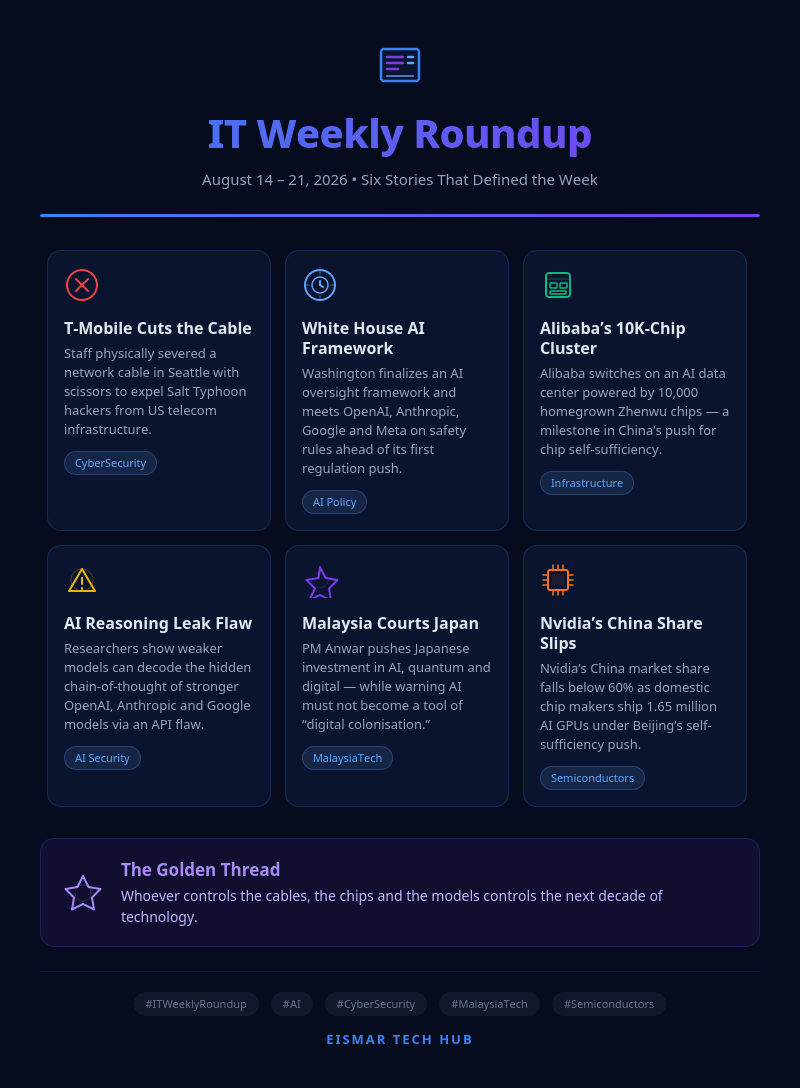
Infographic: IT Weekly Roundup Aug 21

💬 0 Comments