Another eventful week in the world of technology, from Google's AI video ambitions and delays, to a major ransomware attack hitting a household beverage name. Here's what you need to know.
Google Vids Lets You Star in Your Own AI-Created Videos
Google has rolled out a significant update to its Google Vids platform, letting users create custom digital avatars from just a selfie and a voice recording. The feature, announced on July 16, brings Google's Gemini Omni multi-modal AI model into play, enabling prompt-and-image-based video creation with step-by-step editing support.
The technology allows users to generate realistic-looking avatars that can be placed into AI-generated video scenes, complete with synchronized lip movements and natural gestures. All AI-generated content is watermarked using Google's SynthID technology to ensure transparency and prevent misuse.
This move positions Google as a direct competitor to existing AI video platforms like HeyGen, Synthesia, and D-ID, bringing enterprise-grade video generation directly into the Google Workspace ecosystem. For businesses and content creators, this means being able to produce professional-looking video content without expensive studio equipment or actors.
Gemini 3.5 Pro Delayed — Alphabet Shares Slide
It's not all smooth sailing for Google's AI division. Alphabet shares fell 4% on July 16 following reports that the much-anticipated Gemini 3.5 Pro model is months behind schedule. According to sources familiar with the matter, the model's coding capabilities have fallen short of internal expectations, allowing rivals to gain ground.
Competitors haven't been idle. OpenAI recently debuted GPT-5.6 Sol, which boasts 54% better token efficiency on agentic coding tasks, while Meta launched Muse Spark 1.1 with competitive coding benchmarks. An Alphabet spokesperson stated that the company is "currently testing 3.5 Pro, an upgraded Flash model, and other models with partners," suggesting the model is still very much in development but not ready for prime time.
This delay is a reminder that even the world's largest AI companies face significant hurdles in the race for more capable models. For enterprises relying on Google's AI roadmap, this could mean adjusting timelines for AI-powered projects.
Coca-Cola Suspends Fairlife Production After Ransomware Attack
In a stark reminder of the fragility of critical infrastructure, Coca-Cola disclosed to the SEC that its Fairlife dairy division was hit by a ransomware attack, forcing the suspension of U.S. production. Fairlife, which generates approximately $4 billion in annual sales, was forced to temporarily halt operations at its U.S. manufacturing facilities.
The attack specifically impacted U.S. production lines, while Canadian operations remained unaffected. This incident follows a troubling pattern of ransomware attacks targeting food and beverage companies, which have previously resulted in weeks-long production disruptions and empty grocery shelves.
Security researchers note that ransomware groups are increasingly targeting critical food supply chains, recognizing the high-pressure negotiation leverage these targets provide. For IT teams in the food and beverage sector, this incident underscores the critical importance of air-gapped backups, network segmentation, and incident response planning.
SpaceX Starship V3 Aborts After Engine Failure
SpaceX's highly anticipated second Starship V3 launch ended in disappointment on July 16 when four Raptor engines failed to fire, triggering an automatic launch abort. The massive rocket remained on the launch pad as the onboard computer detected the anomaly and shut down the countdown sequence.
Elon Musk confirmed that the team is replacing two of the faulty engines and aims to attempt the launch again next week. The incident comes after the FAA had only just cleared Starship for launch following a review of a May booster failure.
The abort is particularly significant given that SpaceX recently went public on June 12, raising $85 billion. The company's stock currently trades below its IPO price of $135, and the failed launch attempt sent shares down an additional 4% in after-hours trading. Starship V3 is critical for SpaceX's roadmap, including plans for orbital data centers and the next generation of Starlink satellites.
Alibaba and Baidu Shares Surge on Apple AI Partnership in China
In news with significant implications for the Southeast Asian tech ecosystem, Alibaba and Baidu shares jumped on July 16 following China's approval of Apple Intelligence integration. Hong Kong-listed Alibaba shares rose 5%, while Baidu gained 4%.
Under the partnership, Alibaba's Qwen model will be integrated into Apple Intelligence experiences within iOS, iPadOS, macOS, and visionOS for users in China. Baidu is also working with Apple on iPhone-specific AI features, with the company's Kunlunxin chip division reportedly targeting a $50 billion Hong Kong IPO.
This development is particularly relevant for the Malaysian and Southeast Asian market, where Chinese tech giants like Alibaba and Baidu have significant influence. Apple's validation of Chinese AI models signals growing confidence in the region's AI capabilities and could pave the way for similar partnerships across Southeast Asia.
Linus Torvalds Puts His Foot Down: Anti-AI Programmers Told to "Fork It"
In a characteristically blunt statement, Linux creator Linus Torvalds has made his position on AI in software development unmistakably clear. Responding to a heated discussion on the Linux Kernel Mailing List (LKML), Torvalds told anti-AI programmers to "do the open-source thing and fork it."
"AI is a tool, just like other tools we use. And it's clearly a useful one. It may not have been that 'clearly useful' even just a year ago, but it's no longer in question today," Torvalds wrote. His stance was echoed by Linux kernel maintainer Greg Kroah-Hartman, who noted that AI-generated contributions to the kernel have improved significantly — from "slop" to "real reports" over the past year.
The statement sets a significant precedent for the entire open-source ecosystem. While projects like Zig have implemented strict anti-AI policies, the Linux kernel's official position — as the world's largest and most influential open-source project — may shape how other projects approach AI-assisted development going forward.
This Week's Key Takeaways
The common thread running through this week's stories is clear: AI is no longer an experimental technology — it's being embedded into products, debated in kernel mailing lists, and targeted by enterprise rollouts at an accelerating pace. At the same time, cybersecurity threats continue to target critical infrastructure, reminding us that digital resilience must keep pace with digital transformation.
Stay tuned for more insights next week, and don't forget to check out the infographic below for a visual summary of this week's top stories!
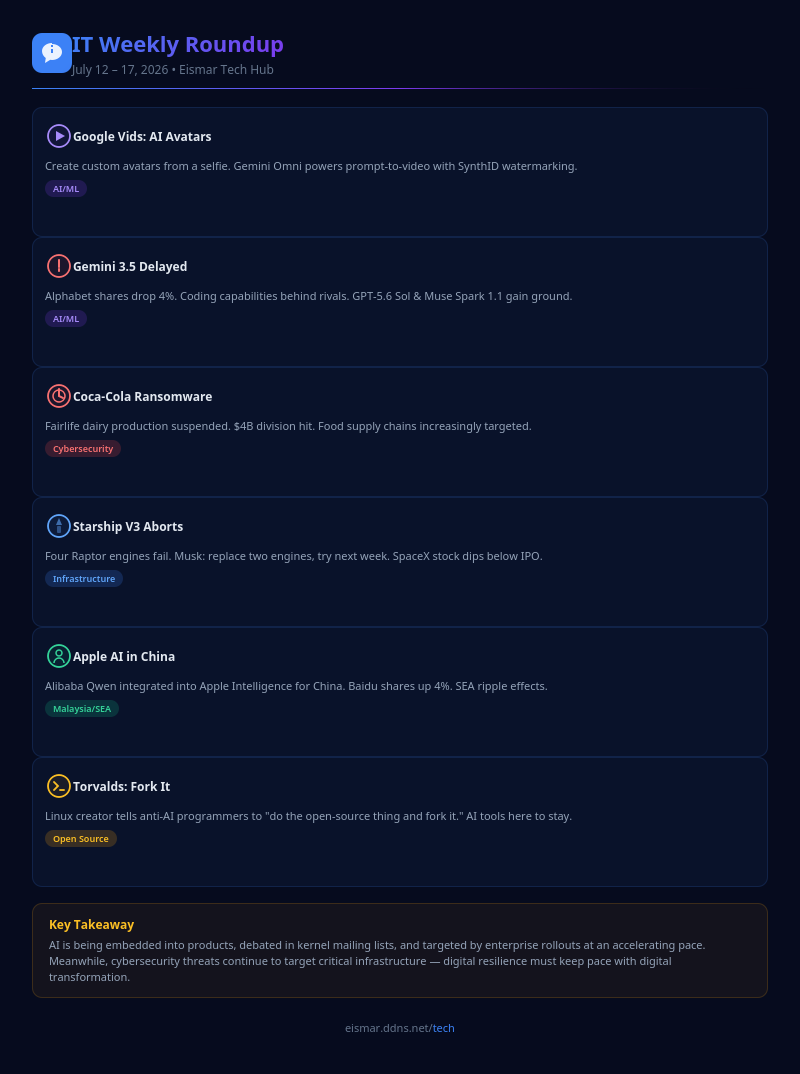
Infographic: IT Weekly Roundup

💬 0 Comments