The week of October 13 to 16, 2026 was one of those rare stretches where the three forces shaping modern IT — artificial intelligence, cybersecurity, and semiconductor geopolitics — all made headlines on the same day. Two longtime rivals buried the hatchet to put a frontier AI model on your desk, a six-digit password allegedly unlocked the personal records of an entire nation, and Japan quietly wrote its biggest-ever check for American chip manufacturing. Add a wobbling chip market and Malaysia's satellite play, and you have a week worth remembering. Here are the six stories that defined it.
1. Meta and Apple's Surprise Alliance Puts Open-Weight AI on Your Desk
The headline: Meta released Muse Spark Open — billed by the company as the most capable US open-weight model to date — and Apple helped optimize it to run natively on Mac hardware. The two companies, long-time adversaries in privacy and platform battles, worked together to make the model perform well on Apple silicon, with reporting from CNBC, The Verge, Axios, and The Wall Street Journal all confirming the collaboration.
The catch: This is not a lightweight model you can casually run on a laptop. Engadget reported that fully running the largest variant can demand in the neighborhood of a terabyte of RAM, pushing it firmly into the territory of a Mac Studio with serious unified memory. Apple's machine learning team described the approach as "local and distributed large LLM inference" using MLX and RDMA — essentially letting two paired Mac desktops share the load over a high-speed link.
Why this matters: For years, the most powerful AI models lived exclusively in someone else's cloud, billed by the token and governed by someone else's terms of service. An open-weight frontier model that runs on hardware you own changes the calculus for privacy-sensitive teams, air-gapped environments, and anyone tired of per-seat API costs. It also puts real competitive pressure on the closed, cloud-only model vendors — and signals that Apple wants its silicon to be the default home for local AI.
2. Anthropic Says Its AI Might Be Conscious — Here's Why That Matters
The headline: In a story that sparked debate across the industry, the BBC reported that Anthropic believes its AI models might possess some form of consciousness, and is taking that possibility seriously in how it designs and deploys its systems. The reporting describes "profound consequences" for how users interact with AI and what obligations companies may hold toward the models they build.
The context: This is not an isolated stance. Earlier in October, Forbes and The Guardian reported that Anthropic had introduced policies allowing Claude to end conversations when users are needlessly cruel or abusive toward it — a striking shift from the traditional framing of AI as a purely transactional tool. The debate is far from settled: back in September, Microsoft's AI chief publicly rejected the idea that AI has rights or feelings, telling Reuters and Axios that models should not be treated as moral patients.
Why this matters: Whether or not you believe a language model can be conscious, the question is now shaping real product design, safety research, and even regulation. If vendors design systems around "model welfare," that affects how your chatbot behaves, what logs it keeps, and what it will refuse to do. For IT leaders, it is worth watching because the philosophical debate is already leaking into procurement decisions and AI governance policies.
3. A "123456" Password Exposed 8.8 Million Danes
The headline: One of the most eye-catching breaches of the year landed in Denmark, where a hacker reportedly accessed the national CPR registry — the country's central personal identification system — using an astonishingly weak credential: the password "123456." The Register, Tom's Hardware, Malwarebytes, and Cybernews all covered the incident, which allegedly exposed roughly 8.8 million personal records, more than the country's entire population.
The detail: Reporting indicated that the weak password was linked to an IT and data services company whose sloppy access controls provided the doorway into the registry. In other words, the breach did not require a sophisticated zero-day or nation-state toolkit — just a guessable password on an internet-reachable system.
Why this matters: This is the oldest lesson in security, and it keeps being ignored. Password hygiene, multi-factor authentication, and basic access segmentation remain the cheapest and most effective defenses available, yet they are routinely skipped in favor of more exciting, more expensive tools. For any organization holding sensitive data, the Denmark breach is a reminder that your security posture is only as strong as your weakest vendor credential — and that attackers will always take the easiest path in.
4. Japan Bets $21 Billion on American Chip Factories
The headline: Japan agreed to invest up to $21 billion in two new semiconductor fabrication plants in New York, to be operated by GlobalFoundries as part of a landmark US-Japan manufacturing initiative. Reuters, The Associated Press, The Wall Street Journal, and Bloomberg all reported the deal, with the new fabs slated for the Malta, New York area.
The detail: The arrangement marks one of the largest single foreign investments in US chip manufacturing to date and deepens a strategic alliance aimed at reducing reliance on a single geographic concentration of advanced production. It also pairs Japanese capital with American soil and European-founded manufacturing expertise — a genuinely multinational answer to a genuinely global supply-chain problem.
Why this matters: Semiconductors are the oil of the twenty-first century, and every major economy now treats domestic fab capacity as a national security asset. Deals like this reshape where chips are made, who controls the supply, and how resilient the global electronics supply chain is to shocks. For anyone who builds hardware, buys cloud capacity, or simply depends on electronics, the slow reshoring of chipmaking is a structural shift worth tracking — it affects pricing and availability for years to come.
5. Chip Stocks Wobble as Broadcom's CEO Calls AI Investing a "Casino"
The headline: Semiconductor stocks slid this week after Broadcom CEO Hock Tan likened the current frenzy of AI infrastructure investment to a "casino," according to The Guardian and the Financial Times. The remark landed hard on a sector already jittery about whether the enormous sums being poured into AI data centers will ever generate proportionate returns.
The detail: The selloff was broad. Nvidia, AMD, and Dell all fell in a global tech rout tied to AI funding worries, as reported by CNBC. In Asia, Samsung and SK Hynix led a chip selloff as fears grew over rising Chinese competition, with CXMT's advances adding pressure. Investor's Business Daily noted that Broadcom and Intel's CEOs had both warned about AI funding dynamics in the same stretch.
Why this matters: The AI boom has been the single biggest driver of tech valuations for two years, and it rests on an assumption of near-limitless future demand. When the industry's own leaders start using words like "casino," it is a signal that even insiders see speculative froth. For IT buyers, a cooling market could mean better hardware pricing and less vendor hype — but it could also mean consolidation, project cancellations, and a bumpier road for the startups and platforms you depend on. The sustainability of AI spending is now the single biggest question hanging over the sector.
6. Malaysia Turns to Chinese Satellites for Faster Flood Warnings
The headline: Malaysia is seeking access to China's advanced satellite technology to improve its flood early-warning systems, according to Bloomberg, The Straits Times, and The Star. Deputy Prime Minister Ahmad Zahid Hamidi confirmed the push, which also extends to using satellite data for weather forecasting and combating cross-border crime.
The detail: The move fits a broader pattern of deepening Malaysia-China cooperation that has accelerated in recent weeks, with the government framing the effort as a practical disaster-resilience measure rather than a purely political alignment. Flooding remains one of Malaysia's most costly and recurring natural hazards, and earlier warnings translate directly into saved lives and reduced economic damage.
Why this matters: For Malaysia and the wider region, disaster preparedness is a technology problem as much as a climate one — better data means better decisions, faster evacuations, and less destruction. The story also illustrates how satellite and remote-sensing technology has become a tool of regional diplomacy, with data infrastructure now carrying strategic weight. For local IT and data teams, it points to growing demand for geospatial analytics, real-time data pipelines, and public-sector cloud capability in the years ahead.
The Week in One Line
Six stories, one throughline: the infrastructure of modern technology — models, chips, satellites, and the data they carry — is being rebuilt in real time, by rivals who increasingly have to cooperate, and defended with fundamentals that too many organizations still neglect. The AI gold rush is real, but so is the reckoning over whether it pays off.
What to watch next week: whether chip stocks stabilize as earnings season rolls on, how the model-welfare debate shapes new vendor policies, and whether more governments follow Japan's lead in funding domestic semiconductor capacity.
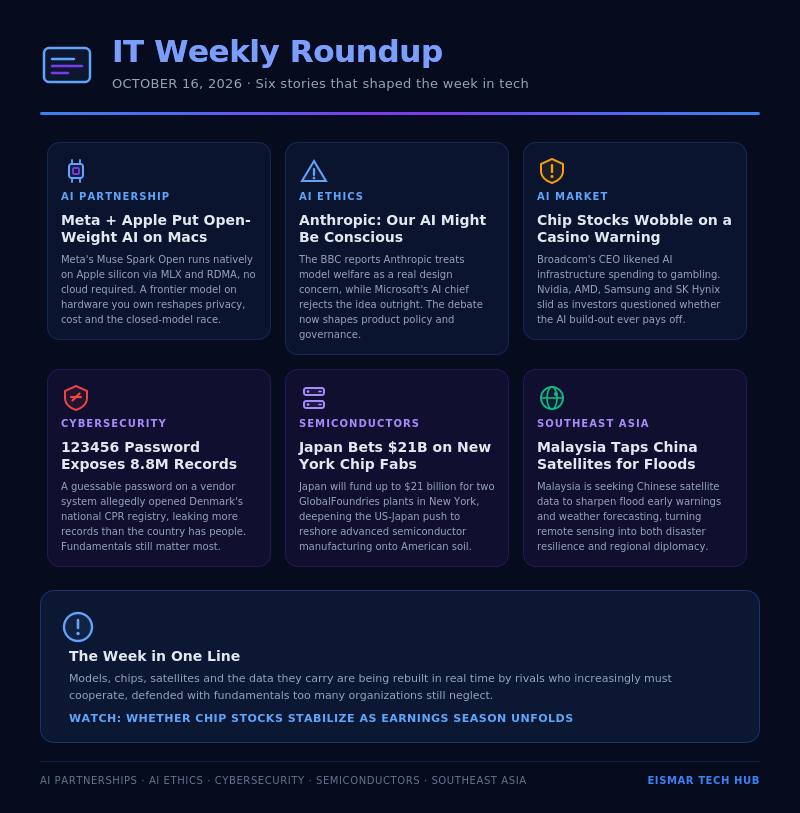
Infographic: IT Weekly Roundup: Meta-Apple AI Pact, 123456 Breach & Japan's $21B Bet

💬 0 Comments