What a week for the business of technology. While the AI safety debate continues to simmer, the money story took centre stage: OpenAI's revenue run rate crossed the $40 billion mark ahead of its much-anticipated IPO, AI chipmaker Cerebras delivered the year's biggest US listing with a debut that popped nearly 70%, and Malaysia cemented its position as one of the surprise winners of the global AI upcycle. Meanwhile, the cyber threat landscape served up two reminders that supply chains — from shipping giants to enterprise software vendors — remain the soft underbelly of the digital economy. Here are the six stories that defined August 10–14, 2026.
1. OpenAI's Revenue Run Rate Tops $40 Billion Ahead of IPO
OpenAI's annualised revenue has crossed the $40 billion mark, and CEO Sam Altman is reportedly pushing for a $1 trillion valuation when the company finally goes public.
Bloomberg reported this week that OpenAI's revenue run rate — a measure of current monthly revenue annualised — has now topped $40 billion, cementing its status as the fastest-growing software company in history. The figure lands as the company prepares for what would be one of the largest tech IPOs ever. Reports suggest Altman is holding firm on a $1 trillion valuation target, a number that has made even seasoned investors uncomfortable. There's also a $40 billion loan deadline hanging over the company's biggest backer, SoftBank, due in 2027 — a financial cliff that analysts say could force the timing of OpenAI's public debut.
Critics remain vocal. Some Wall Street commentators have compared OpenAI's valuation trajectory to the frothier moments of past market cycles, pointing to massive operating losses and the company's unusual non-profit governance structure. But bulls counter that OpenAI's consumer and enterprise growth shows no sign of slowing, with ChatGPT usage continuing to expand across every market segment.
Why this matters: OpenAI's IPO will be the defining event of the AI capital markets cycle. Whether it prices at $500 billion or $1 trillion, it will set the benchmark for every AI company that follows — including Anthropic, which is reportedly preparing its own public listing. For IT leaders, the signal is simpler: the AI buildout is now firmly a Wall Street story, and the money will keep flowing into infrastructure, models, and talent for the foreseeable future.
2. Zuckerberg's 6,500-Word AI Manifesto Sets Out Meta's Ambitions
Mark Zuckerberg published one of his most detailed statements on AI yet — a 6,500-word manifesto arguing that open, decentralised AI is the only path that keeps power from concentrating in a single entity.
The manifesto, published this week, is being read as Meta's clearest attempt yet to position itself as the champion of "open" AI against rivals it accuses of hoarding power. Zuckerberg wrote that the biggest risk facing AI is not a rogue model but "one entity with too much control" — a swipe widely interpreted as aimed at OpenAI and its closed-model strategy. He sketched out a vision where AI is woven into every Meta product, from social platforms to smart glasses, and argued that America's competitive edge depends on keeping AI development open and distributed.
Reaction was swift and split. TechCrunch's take was blunt: "Mark Zuckerberg's AI manifesto is exactly why people don't like AI." Critics pointed out that Meta's own history with data privacy and its closed-source Llama licensing choices undercut the "openness" rhetoric. Supporters, meanwhile, saw a coherent strategy: Meta is betting that a developer ecosystem around open-weight models will outcompete walled gardens, much as Android outcompeted iOS in the smartphone era.
Why this matters: The open vs. closed AI debate is no longer academic — it's now a core part of how the largest tech companies compete. For enterprises choosing their AI platform strategy, this week's manifesto is a useful reminder that vendor positioning around openness should be examined against what the vendor actually ships. Meta's framing will also shape the regulatory conversation, as governments weigh whether to mandate open weights for frontier models.
3. Russia-Linked Cl0p Group Claims Mass Data Theft From Shell, Philips, GE and More
The Cl0p ransomware gang — the same group behind the MOVEit mass exploitation campaign — is claiming to have stolen data from dozens of major corporations, including Shell, Philips, GE, and Fiserv.
Reuters reported this week that Cl0p, a Russia-linked extortion group, claims to have breached the file-transfer infrastructure of a widely used enterprise software vendor, pulling data belonging to Shell, Philips, General Electric, Fiserv, and dozens of other companies. The alleged haul reportedly includes engineering blueprints and corporate documents. Security researchers note the attack pattern mirrors Cl0p's 2023 MOVEit campaign, where a single zero-day in a popular managed file-transfer product gave the gang access to thousands of downstream organisations.
None of the named companies has yet confirmed the extent of the compromise, and Cl0p's claims have not been independently verified. But the group has a track record of following through: in the MOVEit incident, it leaked gigabytes of stolen data when victims refused to pay, causing cascading regulatory and legal fallout across the affected supply chains.
Why this matters: This is a textbook supply-chain attack — one compromised vendor, dozens of household-name victims. It is a stark reminder that your security posture is only as strong as the third-party software your organisation trusts with data. If you use managed file-transfer or document-sharing platforms, now is the time to audit what those vendors know about your business and what your contractual protections look like.
4. CEVA Logistics Breach Ripples Across Banks, Retailers — and Steam Gamers
A cyberattack on shipping giant CEVA Logistics is sending shockwaves through the European supply chain, with Valve confirming that Steam hardware customers' personal data was exposed.
The breach at CEVA Logistics, one of the world's largest freight forwarders, has been making headlines all week as the fallout spreads. TechCrunch reported that the incident is rippling across banks, retailers, and logistics customers throughout Europe. Most visibly, Valve confirmed that customers who purchased Steam Deck and other Steam hardware — shipped via CEVA — may have had names, shipping addresses, and order data exposed. BleepingComputer and The Record both reported that Valve has begun notifying affected customers, and shipping delays caused by the incident have left retailers scrambling.
The breach is a reminder that physical logistics is now deeply intertwined with digital infrastructure. CEVA handles fulfilment for a huge range of companies, and any disruption to its systems — whether ransomware-driven or otherwise — has immediate knock-on effects for consumers and businesses alike.
Why this matters: Supply-chain risk isn't just about software anymore. The companies that move your goods also hold your data, and a breach at one logistics provider can expose customers of dozens of unrelated brands. If you've bought hardware online recently, watch for notification emails — and be extra wary of phishing messages claiming to be "shipping updates" in the coming weeks, since breached logistics data is a goldmine for scammers.
5. Cerebras Pops 68% in the Year's Biggest US IPO
AI chipmaker Cerebras Systems raised $5.55 billion in the largest US IPO of the year, pricing at $185 per share and surging nearly 70% in its Nasdaq debut.
Cerebras, known for its giant wafer-scale AI processors, priced its IPO above the expected range and then some: shares jumped 68% on the first day of trading, pushing the company's market capitalisation to around $95 billion and minting a new generation of AI billionaires in the process. The listing is the strongest signal yet that investor appetite for AI infrastructure remains voracious, even as questions grow about the sustainability of AI valuations.
The company's pitch is distinctive: instead of stitching thousands of small chips together like Nvidia, Cerebras builds one enormous chip — roughly the size of a dinner plate — that keeps data on a single piece of silicon. The architecture is particularly strong for training very large models and for workloads where memory bandwidth is the bottleneck. Analysts note the IPO gives Cerebras a war chest to challenge Nvidia's dominance in training hardware, though software ecosystem and power consumption remain open questions.
Why this matters: The AI infrastructure boom is far from over. Cerebras' blockbuster debut shows that the market is still willing to fund challengers to Nvidia, which is good news for buyers — more competition in AI hardware means more choice and, eventually, better prices for the data centres powering the AI economy.
6. Malaysia Emerges as an AI Upcycle Winner — But Talent Is the Bottleneck
HSBC research identifies Malaysia as a surprise winner of the AI technology upcycle, while Malaysian tech stocks have rallied to a fresh two-year high.
The Edge Malaysia reported this week that HSBC has singled out Malaysia as one of the standout beneficiaries of the global AI buildout, driven by its data centre boom, semiconductor packaging capabilities, and position in the global electronics supply chain. The optimism is showing up in the markets: Malaysian tech stocks have rallied to a two-year high, led by semiconductor names such as SkyeChip and NationGate. The country's push to become a regional AI hub continues to attract international investment, with major hyperscalers expanding local data centre capacity.
But HSBC's note also flagged a significant hurdle: talent. Malaysia's chip ambitions face a shortage of skilled engineers, and the country will need to scale up its workforce to capture the full value of the AI wave rather than serving as a lower-value link in the chain. Digital Minister Gobind Singh Deo has been vocal about the need for home-grown technology and IP, arguing that Malaysia must build its own capabilities to become a true regional AI hub.
Why this matters: For Malaysian IT professionals, this is the most direct economic signal of the year — the AI boom is creating real demand for local engineering talent, data centre expertise, and semiconductor skills. It also means opportunities for upskilling: the countries that win the AI race will be the ones that invest in their people, not just their infrastructure.
The Takeaway
If there's one theme tying this week together, it's that AI has fully entered its capital markets era. OpenAI's run-rate milestone and trillion-dollar ambitions, Cerebras' record-breaking debut, and Meta's open-AI gambit all point to an industry that is now as much a financial story as a technological one. At the same time, the supply-chain security warnings — from Cl0p's corporate data heists to the CEVA logistics breach touching Steam gamers — remind us that as the digital economy grows, so does its attack surface. And close to home, Malaysia's emergence as an AI upcycle winner is a reminder that opportunity is real, but talent will decide who captures it.
Stay curious, stay secure — and we'll see you next week for another roundup on Eismar Tech Hub.
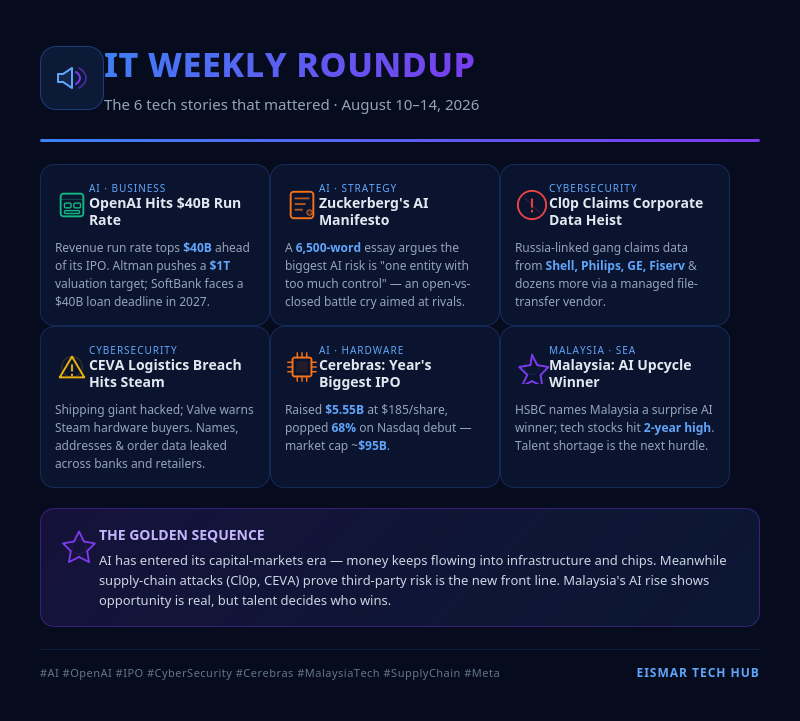
Infographic: IT Weekly Roundup

💬 0 Comments