The week of October 6 to 9, 2026 delivered a stark reminder that the AI boom is no longer just a technology story — it is a financial, geopolitical, and security story all at once. Markets wobbled over OpenAI's real revenue numbers, a fashion retailer's employee inbox became a customer-data breach, two chipmaking rivals shook hands on American soil, and drones struck the physical heart of Russia's internet. Here are the six stories that defined the week.
1. OpenAI's Revenue Reality Check Sinks AI Stocks
The numbers did not add up — and the market noticed.
According to a Financial Times report this week, OpenAI's annualised revenue sits at roughly $50 billion, about $20 billion below the figure investors were told just last month. The gap was wide enough to trigger an immediate selloff across AI-linked equities: Nvidia, Oracle, CoreWeave, and Micron all fell, with Oracle dropping around 5%. Reuters, CNBC, CNN, and MarketWatch carried the story within hours. OpenAI later moved to clarify the figure, with Quartz reporting the company corrected its annualised number to $50 billion.
Why this matters: The entire AI infrastructure supercycle — the data centres, the power contracts, the trillion-dollar capex plans — rests on a single assumption: that model-makers and hyperscalers will generate enough revenue to justify the spend. A $20 billion shortfall between the narrative and the ledger is exactly the kind of detail that makes investors ask harder questions. MarketWatch was quick to argue the reaction reflected "undue concern," but the episode proved something useful: AI valuations are now hypersensitive to revenue credibility. For IT leaders, the practical takeaway is cautionary — the tools and contracts your organisation commits to today are priced on assumptions that the market itself is still testing. Expect earnings season to become a referendum on whether the boom is real or rented.
2. Google Cloud Unveils a "Universal Agent for Work"
Google wants its AI agents to stop borrowing your inbox and start owning their own.
At its enterprise event this week, Google Cloud announced persistent Gemini agents built for long-running tasks — and, more intriguingly, each agent gets its own Gmail, Calendar, and Drive storage. VentureBeat and 9to5Google described the launch as a "universal agent for work," while CIO Dive framed it as Google "unifying fragmented AI agents into a single hub." Orange Spain simultaneously expanded its partnership with Google Cloud to industrialise AI operations using Gemini Enterprise.
Why this matters: There is a real difference between a chatbot that answers a question and an agent that persists, plans, and acts across days. Giving an agent its own identity, mailbox, and file store crosses the line from "tool" to "digital coworker." That is powerful — and it is exactly where enterprise security teams will start asking uncomfortable questions. Who owns an agent's mailbox? What can it read? How do you audit what it did at 3 a.m.? The enterprise agent race is quietly shifting from which model is smartest to whose agent can be trusted with credentials, data, and identity. Google is betting it can answer that first — and with Microsoft pushing Copilot agents and OpenAI courting enterprises directly, the next twelve months will decide which agent platform IT departments actually standardise on.
3. Asos Breach: One Employee Inbox, a Widening Data Trail
A social-engineering attack on a single account escalated into a customer-wide incident.
UK fashion retailer Asos confirmed this week that it suffered a cyberattack and data breach. According to The Record, hackers tricked their way into an employee account through social engineering, and then sent rogue push notifications to customers through the Asos app. The BBC found the scope was wider than first disclosed: names, addresses, phone numbers, emails, and customer numbers were accessed, though passwords reportedly escaped harm. SecurityWeek, The Register, and Infosecurity Magazine all confirmed the incident, while cloud data platform Snowflake publicly denied being the source.
Why this matters: This is a textbook modern breach chain, and every link is worth studying. One compromised employee credential gave attackers internal access. That access let them abuse a trusted, high-reach channel — app push notifications — to unsettle customers directly. And the damage turned out to be broader than the company's first statement admitted, which is precisely how customer trust erodes fastest. The perimeter is no longer a firewall; it is an employee's inbox and an app's notification service. Least-privilege access on internal tools, phishing-resistant MFA, and staged, honest disclosure are the controls that matter here.
4. GlobalFoundries and TSMC's $2 Billion Bet on US Packaging
Two rivals just agreed to cooperate on the scarcest layer of the AI stack.
GlobalFoundries and TSMC signed a five-year agreement valued at $2 billion, under which GlobalFoundries will produce silicon interposers for TSMC's advanced CoWoS AI packaging — on American soil. Tom's Hardware and The Register confirmed the deal, and GlobalFoundries said in its own release that it establishes a US-based supply of silicon interposers for advanced AI packaging. GFS shares rose roughly 4% on the news.
Why this matters: The AI race is no longer bottlenecked solely by how small a transistor can get — it is bottlenecked by advanced packaging. CoWoS is the technology that stacks high-bandwidth memory next to GPUs, and demand for it has outpaced supply for years. Moving a critical slice of that capacity to the United States reduces single-point-of-failure exposure to one island and feeds directly into the "sovereign AI" agenda. That two fierce competitors would collaborate tells you exactly how scarce — and how strategically vital — packaging capacity has become. It also reflects a hard truth of the current cycle: leading-edge fabrication is only half the battle. Without enough advanced packaging to assemble a finished AI accelerator, even the fastest wafer in the world cannot ship.
5. Malaysia Names Five Technologies Critical to Its Sovereignty
A clear signal that Malaysia intends to move from tech consumer to tech producer.
Malaysia's Ministry of Science, Technology and Innovation (MOSTI) told Parliament this week that five of nine technology drivers under the National Technology Sovereignty Framework are "critical to national sovereignty" and carry strong commercial potential. The five are AI-powered systems, sensor technologies (including semiconductors), cybersecurity and encryption, big data analytics, and 5G/6G. The remaining four are blockchain, advanced 3D printing, neuro-technology, and biotechnology.
MOSTI said these drivers will be the primary focus for investment and local capability development by 2030, and will be mapped to five national focus areas: electrical and electronics, advanced materials, healthcare and life sciences, renewable energy, and agriculture and food. Crucially, the ministry flagged that local capacity to adapt AI models to the Malay language and to local sectoral contexts can reduce reliance on generic foreign solutions.
Why this matters: For Malaysian IT professionals, this is the clearest statement yet of where the jobs, funding, and regulation will concentrate over the next five years. Sovereignty frameworks are not just policy documents — they steer procurement, incentives, and talent programmes. The emphasis on semiconductors (an existing Malaysian strength) and cybersecurity (a chronic skills shortage) is particularly telling. Watch for Budget 2027 to mirror these priorities.
6. Bonus: Drones Strike a Russian Data Center — Infrastructure as a Target
The cloud has a physical address — and this week, that address was hit.
Ukrainian drones struck a Yandex data center in Russia — the first major attack on a Russian data hub, according to Reuters. The facility housed two of Yandex's supercomputers. The strike triggered a major internet outage across Russia, reported by CNBC, NBC News, The Kyiv Independent, and Tom's Hardware. Yandex said it was unclear whether the data centre could be restored at all, and the company later hid all four of its cloud data centres on public maps.
Why this matters: For infrastructure planners, this is a wake-up call that has nothing to do with geopolitics and everything to do with design. Data centres are now military targets, and "the cloud" is a building with a power feed and a physical location. Geographic redundancy, failover across regions, and treating physical resilience as a first-class control are no longer enterprise niceties — they are survival requirements. If a hyper-scale operator can lose a facility to a drone strike, your single-region deployment deserves an honest review. The uncomfortable lesson is that resilience is tested not by the threats you model in a risk workshop, but by the ones you never expected a data centre to face.
The Week in One Line
This week, the AI boom finally met its accountant: a revenue shortfall between narrative and reality rattled markets, while the physical foundations of AI — chips, packaging, and data centres — showed both strategic cooperation and kinetic vulnerability. Between the two extremes sits a lesson every IT leader already knows. Growth stories are cheap. Infrastructure, identity, and trust are not.
What to watch next week: whether AI infrastructure stocks recover as earnings season unfolds, and how enterprise security teams respond to Google's persistent agents getting their own inboxes.
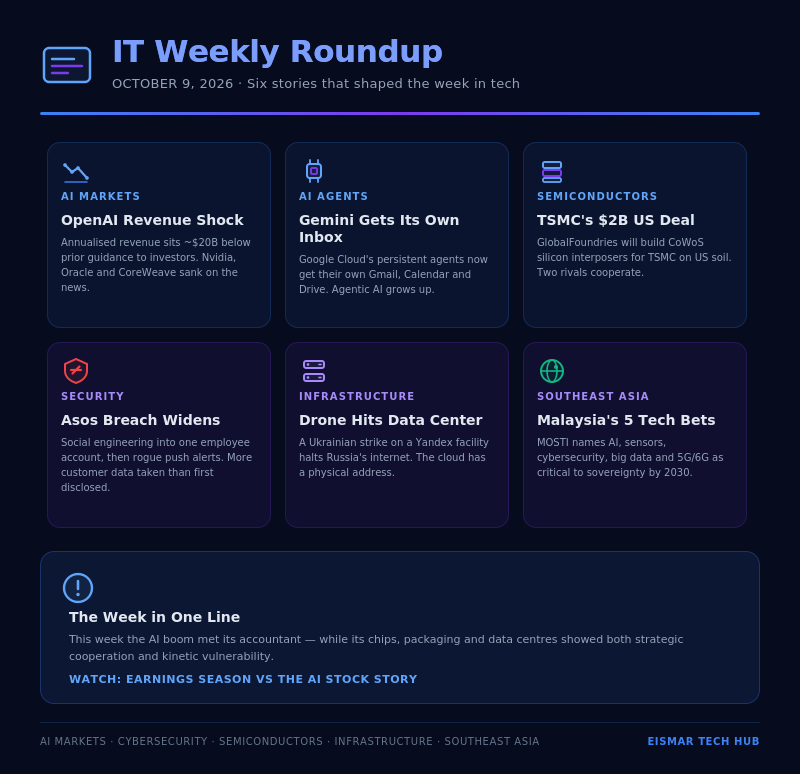
Infographic: IT Weekly Roundup: OpenAI Revenue Shock, Asos Breach & TSMC's $2B Deal

💬 0 Comments