What a week in tech — and September 3 alone delivered enough news to fill a month. OpenAI rolled out its most powerful model yet and declared the start of the "AGI era," Nvidia confirmed one of the biggest acquisitions in AI history, and — as if on cue — ChatGPT, Claude and Grok all went dark at the same time. Meanwhile, the FBI is investigating the dark web sale of more than 153 million driver's licenses, America's two largest school districts slammed the brakes on student AI use, and a small Malaysian startup raised new money to solve one of AI's hottest problems — literally. Here are the six stories that mattered this week.
1. 🤖 OpenAI Launches GPT-6 Astra — "Welcome to the AGI Era"
OpenAI officially released GPT-6 Astra on Thursday, September 3, calling it a "new generation of intelligence" and greeting the world with a bold declaration: "Welcome to the AGI era." The model is being positioned as the company's most capable yet — one that can not only chat but operate your computer, acting as an agent across apps and workflows. It is rolling out across ChatGPT and Codex, with availability through Microsoft Foundry for enterprise teams.
The launch was not without drama. Reuters noted it arrived "amid growing scrutiny over agents' safety," and NBC News reported the model "triggered internal security measures" inside OpenAI — a sign that even its creators are treating its capabilities with extra caution. In a pre-launch post titled Path to Astra, the company outlined the critical capabilities and frontier safeguards behind the release. OpenAI's president went further in interviews, claiming AI is now "as capable as humans" in many tasks — a statement that drew both excitement and raised eyebrows.
Why this matters: Whether or not you agree that this is truly "AGI," the label change matters. When the world's most influential AI lab declares an era shift, it reshapes regulatory debates, enterprise adoption timelines, and what competitors must answer to. The bigger story is the shift toward agentic AI — models that don't just answer questions but take actions on your behalf — which brings a whole new set of safety, security and accountability questions that are only beginning to be asked.
2. 🟢 Nvidia Confirms It Will Buy Hugging Face for $12.9 Billion
The rumour became reality this week: Nvidia confirmed it is acquiring Hugging Face, the beloved open-source AI platform, for $12.9 billion (some reports round it to $13 billion) — one of the largest acquisitions in the company's history. Hugging Face is the de facto home of open-source AI: a massive repository of models, datasets and demo "Spaces" used by millions of developers, researchers and startups worldwide. TechCrunch, CNBC, the WSJ and BBC all confirmed the deal on September 3, after The Information first reported the talks in late August.
What makes the deal striking is the culture clash. Hugging Face was built as a neutral, community-first hub — its CEO Clément Delangue told CNBC the company actually approached Jensen Huang weeks before the deal, and Nvidia has promised Hugging Face will remain an open and neutral platform where rival models stay welcome. Still, analysts at PCMag and elsewhere are already asking whether the chip giant owning the community's favourite sharing platform is "a brilliant move or an antitrust nightmare."
Why this matters: Nvidia already dominates the hardware layer of AI — the GPUs nearly every model trains and runs on. Owning Hugging Face gives it the distribution and community layer on top: the place where models are discovered, downloaded and deployed. For the open-source AI ecosystem, the question is whether a chip giant can truly be a neutral steward of an open community. For Nvidia, it cements its position as the end-to-end AI infrastructure company — hardware, software and now the social graph of AI development.
3. 🔐 FBI Probes Dark Web Sale of 153 Million Driver's Licenses
Identity verification took a gut punch this week. Krebs on Security reported that the FBI is investigating a service selling more than 153 million driver's license records — including scanned images and infrared data used by verification systems — on a new dark web platform. Reuters confirmed the probe, and follow-up reporting linked the leaked data to IDScan.net, an ID-scanning and verification service used by car rental agencies, major retailers and casinos, with brands including Hertz, Target and Caesars named in coverage.
The most chilling detail came from Ars Technica: one of its reporters rented a car, and within hours, his driver's license was listed for sale online. Malwarebytes reported the records include the high-security infrared scans that banks and other institutions rely on to confirm an ID is genuine — which means criminals could use them to defeat verification checks. Hackers have even claimed they obtained the license of US Defense Secretary Pete Hegseth, adding a national-security dimension to an already alarming story.
Why this matters: A driver's license is not a password — you cannot change it after a breach. When 153 million identity documents leak, the damage compounds for years: synthetic identity fraud, account takeovers and loan fraud all become easier. This breach is also a reminder that the weakest link is often a third-party vendor: consumers never gave their license to a hacker, they gave it to a car rental counter. If you live in the US or Canada, this week is a good excuse to check your credit reports, set up alerts, and be extra suspicious of any unexpected account activity.
4. 🏫 NYC and LAUSD Ban AI for Students — The Great Reversal Begins
The two largest school districts in the United States made big headlines this week by moving against student AI use. New York City — the nation's biggest district — announced it will ban generative AI for students through the 8th grade, according to the AP, part of a year-long pause for younger learners. Days later, the Los Angeles Unified School District (LAUSD), the second-largest, adopted a moratorium prohibiting most student use of AI tools, as reported by The New York Times and Education Week.
The reversals are striking because these districts were once AI enthusiasts. LAUSD, in particular, had bet big on AI under former leadership — a bet that imploded spectacularly, with the district's AI program later becoming the centre of FBI raids reported earlier this year. Now the pendulum has swung hard the other way, with officials citing concerns about academic integrity, screen time, developmental readiness of young children, and the lack of evidence that AI tools actually improve learning outcomes.
Why this matters: When the two largest districts in America restrict AI, it sends a signal through the entire education technology market — worth tens of billions of dollars. Edtech companies that built their products around ChatGPT-style features now face a shrinking pool of school customers, at least for younger grades. More broadly, it shows that the "AI in everything" wave is hitting real-world friction: schools are asking harder questions about what AI is actually for in a classroom, and the answer is no longer a foregone conclusion.
5. 🇲🇾 Malaysian Startup nanoSkunkWorkX Raises US$2M to Take On AI's Heat Problem
Malaysia's deep-tech scene produced one of the week's most interesting regional stories: nanoSkunkWorkX (nSWX), a startup developing advanced materials for semiconductor chip packaging, raised US$2 million to tackle what it calls the AI chip packaging bottleneck. Digital News Asia and TNGlobal reported the funding on September 2, with BusinessToday Malaysia framing it neatly — the startup is going after AI's heat problem. As AI accelerators grow more powerful, the heat they generate at the chip's edge has become a critical engineering constraint, and better packaging materials are part of the solution.
The company, founded by a Malaysian entrepreneur with prior experience working with NASA, was first backed by regional VC firm Gobi Partners in 2025. Its focus on advanced packaging materials puts it squarely in one of the most strategic segments of the semiconductor supply chain — the same segment that chip giants and governments worldwide are scrambling to secure.
Why this matters: Malaysia is already a top player in semiconductor assembly and testing, but the industry's real value is migrating toward advanced packaging — precisely the area nSWX is targeting. A successful Malaysian materials startup would help the country climb the semiconductor value chain and reduce reliance on foreign suppliers, aligning neatly with national ambitions to become a regional AI and chip hub. It's a small round in dollar terms, but the direction of travel matters: Malaysian deep tech is starting to aim at the hardest problems, not just the easiest ones.
6. ⚠️ ChatGPT, Claude and Grok All Went Down at the Same Time
In a moment of unintentional irony, the AI industry suffered a rare mass outage on the very day of its biggest launch. On the morning of September 3, users around the world reported simultaneous access problems with ChatGPT, Claude and Grok — with Ars Technica calling it "rare overlapping downtime" affecting four major AI models, as Gemini also showed issues in some regions. Status pages lit up, and thousands of error reports flooded in before services gradually recovered through the afternoon.
The timing fuelled speculation that a surge of traffic around the GPT-6 Astra launch contributed to the strain. Whatever the root cause, the event triggered a wave of practical commentary: Computerworld ran a piece bluntly titled "enterprises need a backup plan," and Decrypt noted users were left asking how to work without AI at all.
Why this matters: For all the talk of AI transforming business, this outage was a reminder of a growing concentration risk. When four of the world's most popular AI services blink at the same time, every company that has baked a single chatbot into its workflows — support, coding, drafting, analysis — discovers it has a single point of failure. The mature response is exactly what Computerworld suggested: treat AI like any other critical infrastructure, with redundancy, fallback processes and a plan for the day the robots all take a nap at once.
By the Numbers: The Week in Tech
| Number | What it means |
|---|---|
| $12.9B | What Nvidia is paying to acquire Hugging Face |
| 153M+ | Driver's license records reportedly for sale on the dark web |
| 2 | US school districts (NYC, LAUSD) that restricted student AI this week |
| US$2M | Raised by Malaysia's nanoSkunkWorkX for AI chip packaging materials |
| 4 | Major AI chatbots that suffered overlapping downtime on Sep 3 |
| 1 | "AGI era" declared — by OpenAI, with the launch of GPT-6 Astra |
Wrapping Up
This week showed both sides of the AI story in a single 24-hour window: OpenAI announcing a new era of intelligence while the industry's most popular chatbots simultaneously went dark; Nvidia spending $13 billion to own the open-source AI community while regulators and school boards worldwide grow more cautious about AI's reach. The through-line is that AI has stopped being a novelty and become critical infrastructure — which means the debates about safety, ownership, concentration and control are no longer theoretical. They are this week's news, and they will be next week's too.
That's it for this week's roundup — see you next Friday. Stay curious, and as always, a smart operator makes informed decisions.
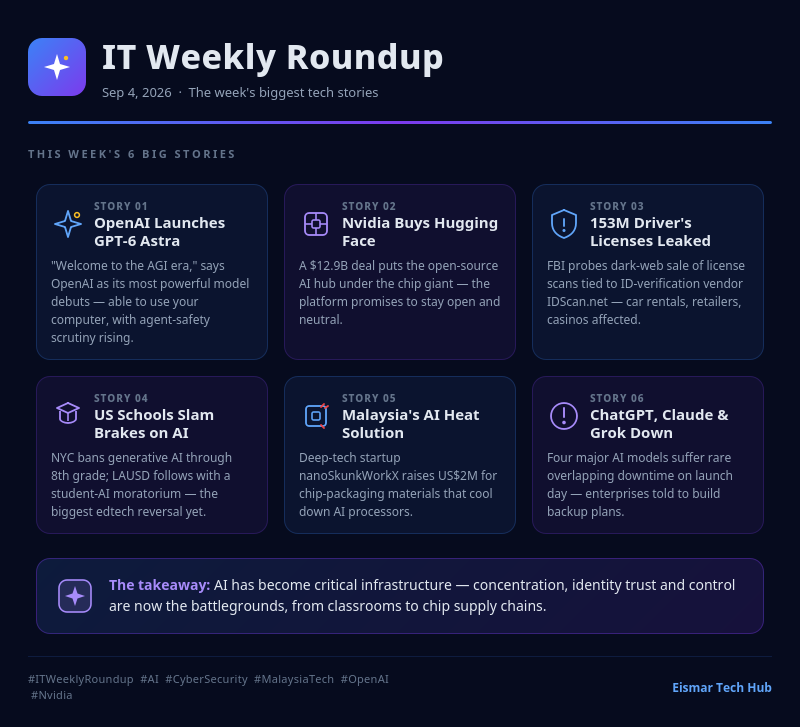
Infographic: IT Weekly Roundup Sep 4, 2026

💬 0 Comments