The last week of June and the first days of July 2026 brought a whirlwind of developments across the technology landscape. From a major US government cybersecurity breach to the escalating environmental cost of AI, and from Meta's bold entry into cloud computing to Malaysia's ambitious chip startup program — here is everything IT professionals need to know.
🔴 US Homeland Security Breach: HSIN Compromised
The Department of Homeland Security (DHS) confirmed this week that its Homeland Security Information Network (HSIN) — a critical intelligence-sharing platform used by federal, state, and local law enforcement agencies — was breached by unknown attackers. TechCrune reported on July 2 that the intrusion began in late May or early June 2026, giving attackers weeks of access before detection.
HSIN is the backbone of inter-agency threat communication in the United States, currently supporting coordination for the FIFA World Cup games hosted across multiple US cities. Senator Mark Warner (D-VA) warned that the exposure "risks national security," adding urgency to the incident. DHS stated it "immediately took action to isolate the affected systems" and launched a full forensic investigation.
Why this matters: This breach is a textbook case of what happens when legacy government information-sharing platforms face modern adversaries. The extended dwell time — weeks before detection — underscores the importance of implementing Zero Trust architectures, continuous monitoring, and rapid incident response capabilities. For IT professionals managing government or critical infrastructure systems, this incident serves as a sobering reminder that no network is immune, especially those supporting high-visibility events like the World Cup.
🌍 AI's Hidden Cost: Google and Amazon Emissions Surge
Both Google and Amazon released their 2025 sustainability reports this week, and the numbers are startling. TechCrunch reported on July 2 that Google's total carbon emissions rose 25% year-over-year, while Amazon's jumped 16%. The primary culprit? Scope 3 emissions — the indirect emissions from the companies' supply chains, including GPU manufacturing and data center construction.
Amazon disclosed it added more than 1.2 gigawatts of data center capacity in Q4 2025 alone — a staggering figure that illustrates the sheer scale of the AI infrastructure buildout. Both companies revealed they are now investing in natural gas plants to meet AI's insatiable power demands, a move that jeopardizes their net-zero pledges.
Why this matters: For IT leaders and cloud architects planning AI workloads, this is the canary in the coal mine. Environmental compliance costs are coming — regulators in the EU, US, and Asia are already drafting data center energy transparency laws. Organizations that fail to account for the carbon footprint of their AI operations may face compliance penalties, reputational damage, and higher operational costs. Expect sustainability metrics to become a key factor in cloud provider selection over the next 12-18 months.
🔧 Anthropic in Talks with Samsung for Custom AI Chip
Anthropic, the AI company behind Claude, is reportedly in early discussions with Samsung to develop a custom AI chip. According to The Information, as reported by TechCrunch on July 2, Anthropic has not yet decided on the chip's specifications or specific use case — but the move signals a strategic shift toward hardware independence.
Anthropic joins a growing list of AI companies pursuing custom silicon. OpenAI partnered with Broadcom on the "Jalapeño" inference processor, while Amazon and Google have long relied on their own Trainium and TPU chips. Anthropic told TechCrunch that a "diversified hardware stack" including Google, Amazon, and Nvidia remains central to its strategy, suggesting the Samsung chip would complement rather than replace existing partnerships.
Why this matters: The AI chip market is rapidly diversifying beyond Nvidia's dominance. For IT infrastructure planners, this means more options, potentially better pricing, and optimized hardware for specific workloads. However, it also introduces complexity — managing workloads across multiple chip architectures (CUDA, TPU, custom ASICs) will require more sophisticated orchestration and middleware. The companies that invest in hardware-agnostic AI pipelines today will have a competitive advantage tomorrow.
☁️ Meta Enters the Cloud Wars
Mark Zuckerberg confirmed this week that Meta will begin selling its excess AI compute capacity to outside customers, marking the company's official entry into cloud computing. CNBC reported on July 2 that Meta's stock surged 9% — its biggest rally in over five months — following the announcement.
Meta raised its 2026 capital expenditure guidance to a jaw-dropping $145 billion and issued $25 billion in bonds to fund the initiative. The company is still debating whether to offer AI model hosting services or raw compute power, but Zuckerberg stated earlier in May that cloud is "definitely on the table."
Wall Street analysts are divided. While the move opens a massive new revenue stream, it also means operating at much slimmer margins than Meta's 98% ad-revenue business. The cloud infrastructure market is capital-intensive and highly competitive, with AWS, Microsoft Azure, and Google Cloud already entrenched.
Why this matters: Meta entering cloud computing could reshape the competitive dynamics of the cloud market. For IT decision-makers, more competition means better pricing and more options for AI-optimized compute instances. However, Meta faces significant challenges — building enterprise trust, achieving regulatory compliance, and matching the service breadth of the Big Three cloud providers will take years. Watch for Meta to initially target AI startups and researchers who value raw GPU power over enterprise features.
🇲🇾 Malaysia Launches SemiconStart: Building the Next Chip Champions
Malaysia officially launched the SemiconStart Malaysia program on July 1, 2026, selecting 10 local semiconductor startups for its inaugural cohort. The program, led by the Malaysian Investment Development Authority (MIDA) and the Malaysia Technology Development Corporation (MTDC), represents the implementation phase of Malaysia's National Semiconductor Strategy.
The selected startups span chip design, advanced packaging, and semiconductor equipment — areas where Malaysia has traditionally been weaker compared to its established strengths in back-end assembly and testing. The program aims to nurture homegrown chip champions that can compete globally, moving Malaysia up the semiconductor value chain.
Why this matters: This is a significant step for Malaysia's tech ecosystem. For IT professionals and engineers in the region, the SemiconStart program signals growing demand for specialized talent in chip design, verification, and fabrication — skills that command premium salaries globally. It also positions Malaysia to capture a larger share of the global semiconductor market, which is projected to exceed $1 trillion by 2030. The success of these 10 startups could pave the way for a thriving local semiconductor ecosystem, reducing Malaysia's dependence on foreign chip designs and creating high-value technology jobs.
🔮 Looking Ahead
This week's news underscores several converging trends that every IT professional should watch:
- Cybersecurity is a boardroom issue — The DHS breach demonstrates that even government systems with significant resources can fall victim to determined attackers. Security can no longer be an afterthought.
- AI's environmental cost is becoming impossible to ignore — With Google's emissions up 25% and Amazon's up 16%, the narrative that AI is "clean" is collapsing. Sustainable AI will be a major differentiator.
- The cloud market is about to get more interesting — Meta's entry, combined with Anthropic's chip ambitions, signals a period of intense competition that could lower costs for consumers.
- Malaysia is serious about semiconductors — The SemiconStart program is not just a PR exercise. Real funding, real companies, and real ambition are behind it.
Stay tuned for next week's edition, and as always — a smart operator makes informed decisions.
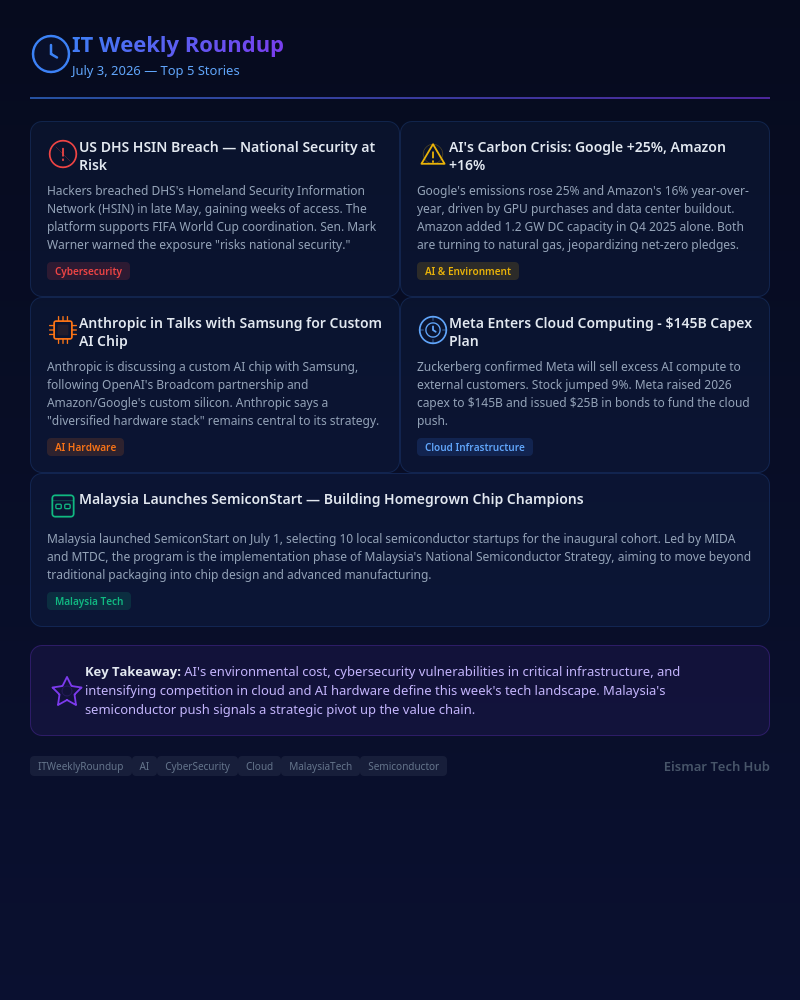
Infographic: IT Weekly Roundup - July 3, 2026

💬 0 Comments