You're lying on a beach in Costa Rica, the sunset is perfect, and you do what millions of us do without thinking: you snap a photo and post it to Instagram and Facebook. No location tag, no geotag, no caption mentioning where you are. Just a beautiful picture of you doing something cool on holiday.
A few days later, while you're still on vacation, a text message arrives. It claims to be from your bank: "We detected unusual activity while you were traveling in Costa Rica — please verify immediately." It feels eerily specific. It feels legit. So you click the link to confirm your details.
Here's the uncomfortable truth: the scammers who sent that message may have figured out where you were from nothing more than the photo you posted — because AI has gotten terrifyingly good at reading the world inside an image. And this isn't a dystopian thought experiment anymore. It's happening right now, and it's happening to ordinary people posting ordinary holiday snaps.
This is the story of how a simple photo can give away your location, why AI is making scams feel scarier and more personal, and — most importantly — what you can do to stay safe without giving up your social media life.
The Study That Should Make You Think Twice
In mid-August 2026, security company McAfee released research that grabbed headlines across The Guardian, Digital Trends, PetaPixel and ConsumerAffairs. The finding was blunt: AI models can now geolocate even the most obscure travel photos — some achieving over 90% accuracy.
Here's how the study worked. McAfee fed more than 20,000 images into two freely available AI vision models and asked each one to figure out where the photo was taken. The results were striking:
- One model correctly identified the location 87% of the time
- The other model nailed it 91% of the time
- When the exact city wasn't identified, the country was almost always correct
As McAfee put it: "That means in roughly 9 out of 10 cases, an AI model that's available for free, to anyone, could look at an ordinary travel photo and correctly name where it was taken."
Think about what that means. You don't need a government spy agency, a private investigator, or expensive surveillance tools. A free AI tool that anyone can download — including a scammer sitting in a call center on the other side of the world — can look at your holiday photo and figure out where you are.
No Metadata? No Problem
Now, you might be thinking: "That's fine, I always turn off location tags on my photos. My phone doesn't embed GPS coordinates." And that's a completely reasonable assumption — but it doesn't save you here.
The scary part of this research is that the AI doesn't rely on metadata or embedded coordinates at all. It just uses the image itself. The model picks up on visual clues that a human might not even consciously notice:
- Architecture and building styles — a Mediterranean villa looks different from a Malaysian shophouse
- Signage and language — shop signs, road markings, and billboards reveal a country instantly
- Landscape and vegetation — palm trees, mountain ranges, desert terrain, or tropical coastlines narrow it down fast
- Light and shadows — the angle of the sun can suggest latitude and even the time of year
- Cars, license plates, and street furniture — all tiny details that give the game away
A human looking at a generic beach photo might say "somewhere tropical." An AI vision model looks at the same photo and says "Kota Kinabalu, Sabah, Malaysia — or somewhere very close." For a scammer, that's more than enough.
And remember, this was tested on freely available models. The proprietary, commercial AI systems that companies keep behind APIs are almost certainly even better at this kind of visual reasoning.
The Scam In Action
So how does a clever AI model become a real-world scam? McAfee's researchers laid out the scenario in detail, and it's chillingly simple.
Say you're on holiday in Costa Rica — the example they used — and you post a photo to your public social media accounts. You didn't tag the location, but the AI model in a scammer's hands just identified the country from your photo's visual clues.
Days later, while you're still abroad, you get a text message that looks like it's from your bank: "We detected unusual activity while you were traveling in Costa Rica — please verify immediately."
Here's the psychology at work: the message references something true and specific — your actual travel destination. That specificity is what makes it feel trustworthy. A generic "your account has been compromised" message is easy to ignore; a message that knows you're in Costa Rica feels like it must be real, because how would a scammer know that?
The victim clicks the link, enters their banking details on a convincing fake login page, and the scammers now have everything they need to drain the account. The AI didn't hack the bank — it just made the lie believable enough for the victim to hand over the keys.
This is the new face of phishing. Traditional phishing casts a wide net and hopes someone bites. AI-powered, location-aware phishing is a targeted spear that lands exactly where you are.
Why This Feels Different From Everything Before
There are three reasons this particular threat is worth paying attention to, even if you consider yourself scam-savvy.
First, the barrier to entry has collapsed. The AI models in the McAfee study are free and accessible to anyone. Scammers don't need coding skills or expensive tools — they need a social media account and a few minutes of training. When a capability becomes free and easy, it becomes mass-deployed very quickly.
Second, the scam is personalized at scale. In the past, personalization meant a scammer manually researching a target — time-consuming and expensive. AI flips the economics: a scammer can process hundreds of vacation photos automatically, extract locations, and fire off targeted messages to every single person. One-to-many personalization is now trivial.
Third, it exploits a moment of vulnerability. People on holiday are relaxed, distracted, and less cautious than usual. They're checking messages on the beach, not scrutinizing URLs. The scam is engineered to hit you at exactly the moment you're least likely to think critically.
How To Protect Yourself (Without Going Offline)
The good news is that you don't need to stop posting photos or delete your social media to stay safe. The experts who covered this research — including The Guardian, PetaPixel, and McAfee itself — converged on a practical set of habits that dramatically reduce your risk.
1. Delay posting until you're home
This is the single most effective fix, and The Guardian recommends it outright. If you're still on holiday, the location embedded in your photo is current — it tells a scammer where you are right now. If you wait until you're back home, the photo reveals where you were, which is useless for a targeted scam. Your memories don't expire; post the best shots when you're safely home and the trip is over.
2. Lock down who can see your photos
Change your social media settings so that only trusted people — not the entire public — can see your posts. McAfee and the researchers all pointed to this as a core defense. A scammer can't geolocate a photo they can't see. If your account is public, assume every photo you post is being analyzed by someone, somewhere.
3. Treat location references as a red flag, not proof
This one flips your instincts on their head. When a message references your travel destination, your first thought is "it must be real, they know where I am." But the researchers were explicit: a message that knows where you are is more likely to be a scam, not less. Scammers use location familiarity precisely because it feels reassuring. Genuine banks don't need to prove they know your location — they already have your account on file.
4. Never click links in unexpected texts or emails
If a message asks you to "verify immediately," resist the urge to click. Instead, open your banking app or go to the bank's official website directly — type the address yourself, or use the app you already have installed. If the message was real, you'll find the alert there. If it was fake, you've just dodged a bullet.
5. Remember the golden rule: urgency is the scammer's best friend
Every scam in the book relies on urgency — "act now," "verify immediately," "your account will be locked." That pressure is designed to bypass your rational brain. The moment you feel rushed, that's the moment to slow down. Real banks never demand instant action through a text message link.
The Bigger Picture
This story is a snapshot of where AI and everyday life are colliding in 2026. We've spent the last few years marveling at what AI can create — images, videos, music, writing. But AI is also becoming a master of observation, and that's a double-edged sword.
The same vision capabilities that let AI identify a landmark in your holiday photo are the ones being used by scammers to target you. The technology isn't malicious by itself — but it's free, it's powerful, and it's in everyone's hands, including the wrong ones.
There's also a deeper lesson here for everyone who uses social media: privacy is no longer about what you explicitly share. You might not tag your location, but the background of your photo — the architecture, the signage, the light — shares it for you. The information is already out there; the question is who's looking at it and what they're doing with it.
This doesn't mean you should live in fear. It means you should be deliberate. Post later. Lock down your audience. Question messages that know too much. These are small habits with an outsized payoff.
What You Can Do This Weekend
If this article has made you want to tighten up your own habits, here's a quick weekend checklist:
- Check your social media privacy settings — who can see your photos right now? If the answer is "everyone," consider changing it.
- Look at your recent posts — did you post anything that reveals where you live, work, or are vacationing? Remove or archive anything too revealing.
- Enable two-factor authentication on your bank accounts and email — even if a scammer gets your password, 2FA can stop them cold.
- Talk to family and friends — especially older relatives who are prime targets for this kind of personalized scam. A five-minute conversation can save them thousands.
- Take the "delayed posting" pledge — for your next trip, try posting photos after you return. You'll be surprised how little you miss it.
Conclusion
The McAfee research is a wake-up call wrapped in a fascinating piece of AI capability: a free AI model can look at an ordinary vacation photo and correctly identify where it was taken roughly 9 times out of 10 — no metadata required. And scammers are already turning that capability into targeted, location-aware phishing attacks that feel eerily real.
But here's the thing: you're not powerless. The defenses are simple, free, and within everyone's reach. Delay your posts. Lock down your audience. Treat location references as a warning sign instead of proof. And when a message demands immediate action, take a breath before you click.
The AI era is teaching us all a new kind of digital literacy — and the smartest move is to learn it now, before the scammers get any smarter.
Stay safe out there, and happy posting — just maybe not until you're back home. 🌴
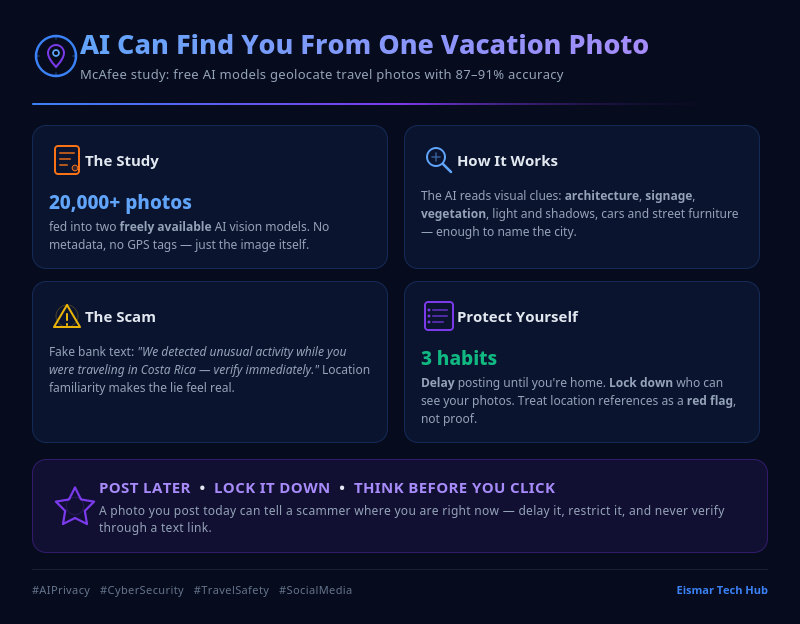
Infographic: Your Vacation Photos Are Telling AI Scammers Where You Are
💬 0 Comments