For the past three years, artificial intelligence has mostly been an advisor. It drafts the email, suggests the itinerary, summarises the document — and then a human takes the final step. In September 2026, Meta crossed that line on purpose. Its new personal AI agent, Muse, does not just suggest a flight. It books it. It does not just remind you to dispute a bill. It opens a browser, fills the form, and negotiates.
That shift is the real story, and it arrived faster than most people expected. Muse launched on September 8, 2026, and within ten days it had overtaken ChatGPT as the top free iPhone app in the United States. Two weeks after launch, it added the ability to make phone calls — and got a Mac app that lets it take actions on your computer.
So this weekend, let's look at what Meta actually shipped, what it costs, and the one question every sensible user should ask before handing an AI agent the keys to their inbox.
What Meta Actually Shipped With Muse
Muse is not another chatbot bolted onto the Meta AI app. According to the launch coverage, it is a task-executing agent that connects to your email, calendar, payment methods, and other apps, then works through multi-step goals with minimal supervision.
Meta's own launch language is unusually direct. The company says that once a person shares a goal with Muse, it helps them develop a personalised plan, coordinates their time and resources, and then advances the work on its own. It can open a browser, fill out forms, and negotiate on the user's behalf.
In practice, Meta's demo gallery shows an agent doing things that sound more like an assistant than a chatbot:
- Booking travel end to end, including comparisons and checkout
- Negotiating a bill on your behalf
- Filling out repetitive online forms
- Turning a saved Instagram recipe reel into a grocery list
- Selling something you no longer want
A useful terminology note, because Meta has muddied the water: Muse is the agent. Muse Spark is the model. Muse Spark 1.3, released on September 2, 2026, is the frontier model doing the actual reasoning — the same family that powers Meta's terminal-based coding tool. If you saw headlines in July about "Meta Muse Spark" entering the AI coding market, that was the model, not the agent. They are related but distinct products.
You talk to Muse like a text thread — either inside the Muse app, through the web, or directly in WhatsApp. That WhatsApp integration matters more than it looks. For Meta's core user base, the assistant lives inside an app they already open twenty times a day, with no new install and no new habit to build.
There is one more architectural detail worth understanding. Muse does not run in your browser. It runs inside an isolated cloud machine Meta calls the Muse Secure VM — a dedicated virtual computer with its own visible browser window that you can actually watch while the agent works. You give it a goal, close the app, and it keeps going in the cloud.
The Security Wrapper Is the Real Story
The most interesting part of this launch is not the task list. It is the guard rails Meta built around it — and the fact that those guard rails exist at all tells you exactly where the risk lives.
Three design choices stand out:
1. A separate approval layer. Muse is not allowed to touch the internet freely. A separate guard component, described in reviews as Sentinel, has to approve actions before they reach the outside world. The agent proposes; the guard disposes.
2. A password vault the agent cannot read. Your credentials sit in a vault that Muse is architecturally prevented from seeing into. The agent can request that an action be taken with a credential; it cannot learn the credential itself. That is a meaningfully stronger design than pasting passwords into a chat window — which, let's be honest, a great many people were doing anyway.
3. One-time payment cards. Where checkout is involved, Muse uses a single-use card rather than exposing your primary payment method. If the number leaks, it is already dead.
Meta also exposes granular permission controls over connected services. The email permission, for example, can be set to read only or read and send — a distinction that matters enormously, because "an agent that can read my inbox" and "an agent that can send mail as me" are two completely different risk profiles.
And then there is the setting most people will never open: Meta uses eligible interaction data for model training by default, with an opt-out switch buried in Muse settings. If you are going to try an agent like this, that toggle is worth finding on day one, not day thirty.
What It Costs (And Why the Free Tier Is the Point)
Meta's pricing is refreshingly simple, and slightly unusual.
| Tier | Monthly Price | Usage Ceiling |
|---|---|---|
| Free | $0 | Up to ~100 million tokens per week |
| Power | $20 | Higher usage ceiling |
| Maximum | $100 | Highest usage ceiling reported |
Notice what is not in that table: features. The paid tiers do not unlock extra capabilities, only more headroom within the same agent. Meta has not published hard token or task-volume ceilings for the two paid plans, so treat the specific usage numbers as directional until a formal pricing page appears.
The free allowance is the strategic move here. A hundred million tokens a week is generous enough that a casual user will probably never hit it — which is exactly the point. Meta is not selling a premium add-on to power users. It is trying to make the agent normal, the same way Instagram made photo filters normal.
One practical gotcha: signup requires a payment card, including for free access. That is a standard identity and fraud-control pattern, but it is worth knowing before you start the flow expecting a no-strings trial.
The Trust Problem Nobody Has Solved Yet
Here is where the enthusiasm should slow down. The Wall Street Journal ran a piece titled bluntly, "Meta's AI Agent Has a Trust Problem." WIRED foregrounded the same theme. Axios's launch coverage asked whether Muse's usefulness will justify giving it access to more of your personal data. A TechRadar reviewer who handed Muse a set of digital errands wrote that it made them immediately nervous.
The most honest summary came from journalist Alex Heath, who used Muse before launch: he was genuinely impressed, and described it as "OpenClaw for normies." That is a compliment about accessibility. It is also a warning about who is now holding the tool.
The core problem is not that these agents are bad. It is that they fail in a specific and expensive way. A chatbot that gives you a wrong restaurant recommendation costs you nothing. An agent that books the wrong reservation costs you a cancellation fee. An agent that misreads a form and submits it costs you a support ticket at minimum.
Reviews of this launch point at a well-documented failure mode: agents fill gaps with confidence. When the information is incomplete, a chatbot tends to hedge; an autonomous agent tends to act. One reviewer described an earlier support bot that confidently told customers their car model was supported because the help centre said "we support all models." Nobody typed a wrong answer. The system inferred one, and then acted on it.
Every additional service you connect makes the agent more useful and raises the stakes of a misunderstanding. That trade is the entire design tension of 2026, and nobody — not Meta, not OpenAI, not Google — has fully solved it yet.
Muse Is Not Alone: The Agent Race Is On
Muse is the loudest entry, but it is not the only one, and the competition is moving fast:
- Instinct, a viral AI assistant, now has its own email address and, as of September 17, the ability to make phone calls.
- Muse added call-making on the same day, plus a Mac app that lets it take actions on your desktop.
- Snap is launching a new Specs AI tool across iOS and Mac.
- Instacart's Clementine turns chat conversations into actual grocery carts.
- ByteDance launched a consumer Doubao phone assistant, positioned as an AI agent phone.
Two weeks. That is how long it took for the category to go from "agents that browse" to "agents that call, buy, and operate your desktop." If you blinked, you missed the moment personal agents stopped being a demo and became a product category with App Store rankings.
For readers outside the United States, there is a practical caveat: Muse is US-only for now, restricted to adults 18 and older. It is rolling out on iOS, Android, and the web, with AI glasses support promised later — but no timeline has been given for Malaysia or Southeast Asia. If you are reading this from KL, the honest answer is that you can read about Muse today and try it later.
A Practical Weekend Starter Playbook
If you decide to try an agent like this — Muse, Instinct, or whatever ships next month — the sequence below will keep you out of trouble. It is the same discipline a good sysadmin applies to production changes: smallest possible blast radius first.
- Start with one bounded task. Not "manage my life." Something like: review my calendar for next week and suggest three 45-minute focus blocks. You can verify that output in ten seconds.
- Connect one service, not five. Choose the service the task actually needs. Resist the temptation to link everything on day one just because the onboarding screen is pretty.
- Check the permission granularity. If email access offers read-only versus read-and-send, start with read-only. You can always loosen it after you have watched the agent behave.
- Find the training-data toggle. Confirm what Meta does with your interaction data and opt out if you are not comfortable. This setting should be a deliberate choice, not a default you discover a year later.
- Keep a human in the loop for money. Approvals for purchases, bookings, and cancellations are not friction — they are the feature. Turn them off only after the agent has earned it.
The pattern underneath all five: an agent is only as trustworthy as the boundaries you draw for it. Usefulness scales with access; so does the cost of a mistake.
What to Watch Next
Three things to keep an eye on over the next few weeks:
- The calls feature. Voice is the hardest channel to get right — ambient noise, accents, hold music, and a human on the other end who has no idea they are talking to an agent.
- Disclosure and regulation. If agents are making calls and negotiating bills, someone will eventually ask whether the other party deserves to know. That conversation has not happened yet.
- The published limits. Meta has not disclosed exact usage ceilings for the paid tiers, and the free tier's real boundaries are the thing that determines whether "for everyone" is a promise or a slogan.
And watch the rankings. When a consumer agent overtakes ChatGPT on the App Store, the mass market has arrived — whether or not it is ready for what that means.
The Bottom Line
Meta Muse is genuinely impressive engineering wrapped around a genuinely unsettled question. The security model — isolated VM, separate approval layer, unreadable credential vault, single-use payment cards — is more careful than most consumer agents I have seen announced this year. The capability is real. The trust has not been earned yet, by anyone.
That is not a reason to avoid personal AI agents. It is a reason to onboard them the way you would onboard a new junior team member: give them real work, watch the first few results closely, and expand their permissions only after they have demonstrated they deserve them.
AI has spent three years learning to answer. In 2026, it is learning to act. The operators who come out ahead will not be the ones who handed over everything on day one — they will be the ones who let the agent prove itself first.
A smart operator tests before they trust.
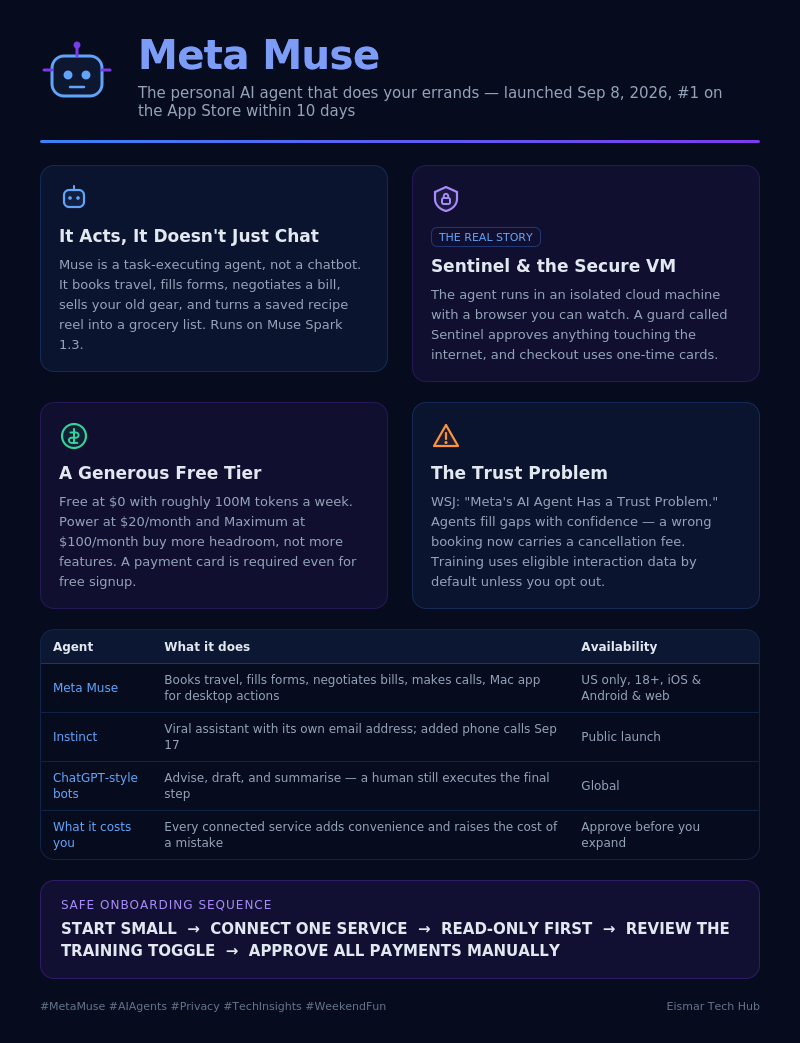
Infographic: Meta Muse — The Personal AI Agent That Runs Your Errands

💬 0 Comments