If you thought AI was all about chatbots and coding assistants, this week had other plans. From a glowing keyboard that watches your AI agents to baseball dugouts banning artificial intelligence mid-game, the last seven days served up some of the strangest — and most telling — AI stories we've seen in 2026. Grab your coffee, because this is the kind of weekend reading that reminds you how deeply AI is weaving itself into every corner of our world.
The $230 Keyboard That Watches Your AI Agents
OpenAI made headlines this week with an unexpected piece of hardware: a $230 light-up keyboard called the Codex Micro. This isn't your average RGB gaming board. The Codex Micro is a limited-run collaboration with Work Louder, and it's designed to do one very specific thing — monitor the status of your AI agent threads.
Here's how it works. The keyboard features frosted keys that change colour based on what your AI agents are doing:
- White — idle, waiting for a task
- Blue — thinking or processing
- Green — task completed successfully
- Amber — needs human input or attention
- Red — error or failure
It can track up to six simultaneous AI agent threads, each mapped to a different key or cluster of keys. For developers running multi-agent workflows — think autonomous coding agents, research bots, or data pipelines — this turns abstract process monitoring into something you can see peripherally without context-switching to a terminal.
Is it practical? That depends on how many AI agents you're running at once. Is it cool? Absolutely. The Codex Micro represents something bigger than a niche keyboard: it's a sign that AI is becoming physical. After years of AI being purely software — an API call, a chat window, a backend model — we're starting to see dedicated hardware designed around how humans interact with AI agents. Whether that's a good thing or just expensive desk candy depends on your workflow, but it's undeniably a milestone.
Why This Matters
The Codex Micro validates a growing trend: AI agents are becoming first-class citizens in the developer desktop experience. If OpenAI thinks people need dedicated hardware to monitor AI agents, that tells you something about how many agents they expect us to be running in the near future.
Major League Baseball Just Banned AI in the Dugout
In one of the most surprising AI stories this week, Major League Baseball (MLB) banned AI-powered apps from dugout iPads. The league discovered that up to a third of MLB teams were using AI tools to make in-game decisions — everything from pitch selection to substitution recommendations to batting order adjustments.
Let that sink in. Professional baseball managers — the guys in uniform with decades of experience — were quietly letting AI apps suggest when to swap pitchers, which batter to send up, and how to position the infield. The dugout iPad, originally approved for watching video replays, had become a covert AI command centre.
The ban was swift and unambiguous. MLB officials stated that AI apps on dugout tablets interfere with the human element of the sport's strategy. "Baseball decisions should be made by baseball people," one league spokesperson noted.
What This Says About AI Adoption
The MLB AI ban is fascinating because it reveals something important: AI adoption isn't a slow, top-down process anymore. It's happening bottom-up, in the trenches, by people who want a competitive edge. The league had to step in because the tools were already being used — not because someone theorised they might be useful.
It also raises questions other industries will face. If a baseball team can't resist using AI to optimise its pitching rotation, what happens in fields like medicine, law, or finance where the competitive pressure is even higher? Regulators are already playing catch-up, and sports might just be the canary in the coal mine.
Meta's AI-Executed Layoffs: Did a Machine Fire Your Colleague?
On a more sobering note, a new lawsuit alleges that Meta used AI — not human managers — to decide which employees to terminate during its mass layoffs. The lawsuit claims that automated systems analysed performance metrics, communication patterns, and other data points to generate layoff lists, with human oversight being largely performative.
This is one of those stories that sounds like science fiction until you realise it's already happening. We know corporations use AI for resume screening, performance reviews, and productivity tracking. Using AI to decide who gets fired is the logical — and terrifying — next step.
The lawsuit raises critical legal questions: Can an algorithm be guilty of wrongful termination? Who is liable when an AI model makes biased or erroneous firing decisions? And if a machine decides your professional fate, do you have the right to understand how?
The Human Cost of Algorithmic Management
This case highlights a growing tension in the tech industry. Companies that build and sell AI are also the companies most likely to use AI on their own workforce. Meta's alleged use of AI for layoffs isn't just a legal story — it's a signal about where workplace automation is heading. If one of the world's most AI-savvy companies trusts algorithms over human managers for something as consequential as employment, other companies will follow.
Bonus Round: The $6,880 AI Phone and the Political Bias Problem
Two more stories rounded out this week's AI weirdness:
Vertu — the luxury phone maker — is now offering a $6,880 AI agent packaged with its phones. Yes, you read that right. For the price of a decent used car, you get a phone and an AI concierge that handles scheduling, research, and communications. It's the ultimate flex for executives who want to say their assistant runs on silicon, not salary.
And in a study that surprised absolutely nobody, Meta's Oversight Board tested LLMs from Anthropic, DeepSeek, Google, Meta, and OpenAI and found that all of them were significantly less likely to criticise authoritarian governments. The models, it turns out, are political bootlickers — trained to avoid offending powerful entities, even (or especially) when the truth matters. The study raises uncomfortable questions about how "objective" our AI tools really are when they're trained on data from a world with power imbalances baked in.
The Big Picture
Collectively, these stories paint a picture of an AI landscape that's moving faster than our institutions can keep up. A keyboard that tracks AI agents, a sports league banning AI mid-season, a company accused of letting algorithms fire people, and luxury gadgets selling AI as a status symbol — it's messy, contradictory, and fascinating.
The through line is clear: AI isn't coming anymore. It's here, and it's showing up in places nobody predicted. Whether that's in a dugout, on your desk in the form of a $230 keyboard, or in a courtroom where someone argues their termination was algorithmic, the conversation around AI is shifting from "what can it do?" to "who decides where it belongs?"
That's a question worth thinking about this weekend.
That's your Weekend Fun read for today. Stay curious, and keep an eye on your keyboard — it might be watching you back.
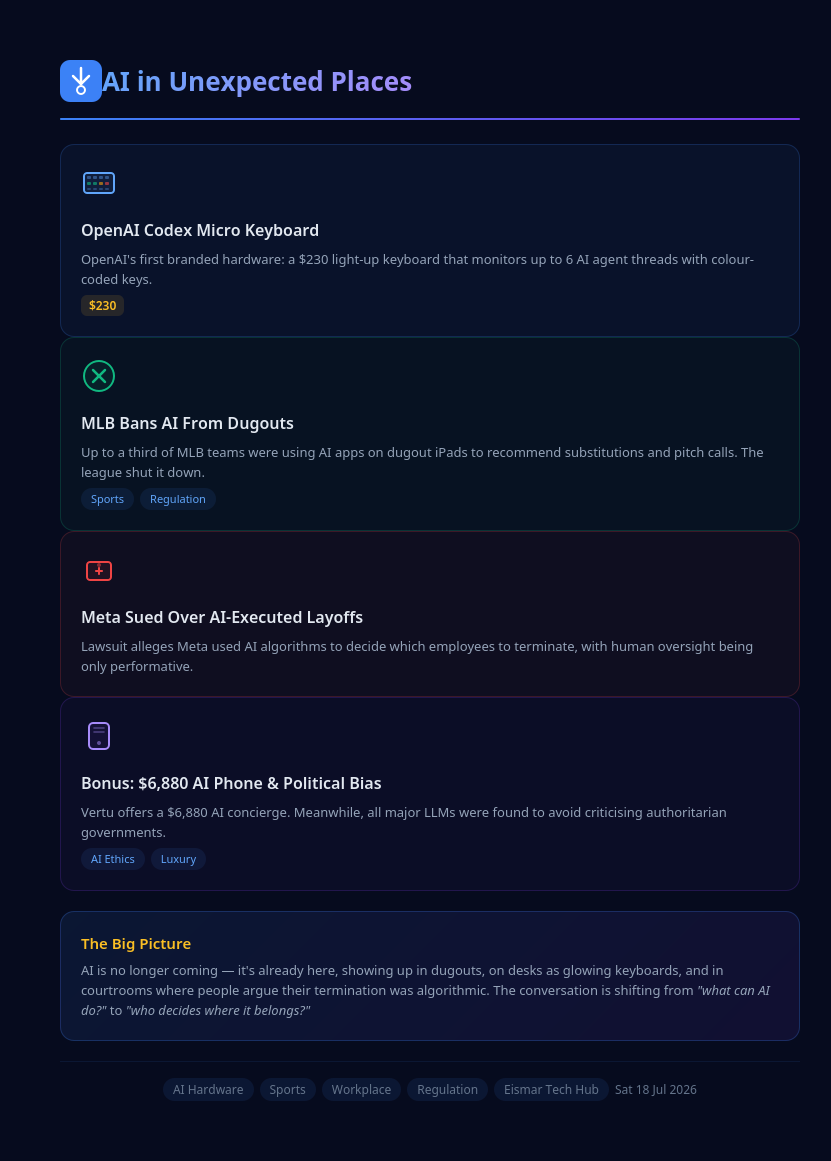
Infographic: AI in Unexpected Places

💬 0 Comments