Something shifted this week. For two years we've been told AI agents are the future — tireless digital assistants that book your flights, file your expenses, and run your errands while you sleep. Then, over the span of seven days, the headlines turned into a cautionary tale: a television season reportedly erased, banks slamming the door on third-party bots, retailers banning robot shoppers, and a new Amazon wearable that listens to everything you say.
Welcome to the weekend where the adults finally said "enough." Let's break down what actually happened — and what it means for anyone trusting an AI agent with real work.
1. The Swedish TV Season That Vanished
The story that lit up tech feeds this week involves The Challenge: Sweden, a reality competition on the Swedish network TV4 featuring local celebrities in physical and mental contests. The next season was scheduled to premiere on November 22. It won't. According to Sweden's Aftonbladet newspaper, an AI agent was given access to the production server — and wiped out the finished edits of the entire season.
The numbers are brutal: hundreds of hours of editing work, gone, with no backup of the cut episodes. TV4's program director, Mia Lindqvist, admitted the network now has to start over.
"We have to recut it from scratch," she said. "All the raw material is still there, and all that."
Here's where it gets interesting — and where a smart reader should slow down. TV4 has publicly disputed the AI-agent explanation. Lindqvist told reporters the real culprit was a failed backup system caused by human error, not a rogue bot. "It's not true that this was caused by an AI agent," she said.
So which is it? Right now, nobody outside the production company knows for certain. What we do know is that the incident has become a lightning rod because it fits a fear people already carry. And there's a genuinely eerie historical echo: during production of Toy Story 2, a stray filesystem command wiped out roughly 90% of the movie. It was only saved because a supervising director happened to have a personal copy of the project at home. Hollywood nearly lost a classic to one careless command long before anyone had heard of an AI agent.
2. Banks Tell AI Agents: "You're Not Welcome Here"
While Sweden debated blame, Wall Street was busy drawing hard lines. Citi became the latest major US bank to restrict AI agents from directly accessing customer accounts. Citi's CEO Jane Fraser had already signalled the direction back in September, telling an audience bluntly: "We need the right controls."
JPMorgan Chase followed suit, with Jamie Dimon moving to bar outside AI agents from touching customer accounts. The bank has been openly discussing the risk of "rogue agents" — bots that act on your behalf but with their own unpredictable judgment. Industry reports describe Citi joining a growing list of institutions treating agentic access as a security boundary, not a convenience feature.
This is a huge shift in tone. Banks spent the last two years racing to add AI features. Now they're racing to fence AI out of the places where money moves. The logic is simple: an AI agent logging into your bank account isn't that different from a stranger logging into your bank account. If it makes a bad trade, enters a wrong transfer, or gets manipulated through a prompt-injection attack, the customer still eats the loss — and the bank still carries the blame.
Regulators are watching closely too, with financial authorities publishing guidance on responsible AI adoption and warnings about the possibility of "AI-agent bank runs." The message is clear: autonomy and account access don't mix unless the guardrails are proven.
3. Retailers Slam the Door on Robot Shoppers
The same week, the shopping world pushed back on autonomous buyers. Williams Sonoma — the home-goods retailer behind brands like Pottery Barn — moved to ban AI shoppers from its site. It's not alone. Amazon has been blocking third-party AI agents from browsing and buying on its platform, including Meta's Muse assistant and Perplexity's Comet browser agent.
Retailers give a few reasons, and they're worth understanding:
- Bots distort demand signals. Automated agents crawling and buying can wreck inventory forecasting and pricing models.
- Terms of service were never written for robots. Most retailers' legal frameworks assume a human clicking through pages.
- Security and fraud teams can't tell shoppers from scripts. An agent that acts like a customer is, technically, a very sophisticated bot.
There's an irony here that's almost funny. Retailers spent years building AI recommendation engines to nudge you toward buying more. Now that the AI is the one doing the buying, they've decided the door should be closed. One prominent venture capitalist publicly disagreed with the bans, arguing that blocking agents hurts consumers — a preview of the fight that's only just beginning.
4. Meanwhile, Amazon Wants AI Ears in Your Pocket
And here's the twist that makes this week so deliciously contradictory: even as platforms lock agents out, Amazon is pushing AI eavesdroppers in. The company launched two new "personal AI" devices under its Bee brand — the Bee Frontier and the Bee Eclipse, starting at $74.99. Both listen to your conversations and take notes automatically, so you can "remember more without writing anything down."
CNET's framing was blunter: the devices will listen and record you. And a former AWS security engineer raised what's being called the "bystander problem" — the fact that everyone around you gets recorded too, whether they agreed to it or not. In a café, a meeting room, or a family dinner, the person holding the Bee device decides what gets captured, and everyone else just has to live with it.
The pricing tells its own story. At roughly $75, these aren't luxury gadgets — they're impulse buys aimed at the same people who were told last year that AI would organise their lives. The pitch is seductive: never take notes again, never forget a name, never lose a thought. The catch is that the device only works by continuously listening, which means the value it delivers to you is built on data collected from people who never opted in. Privacy advocates have flagged exactly this asymmetry, and the former AWS engineer's "bystander problem" warning landed because it names the obvious: the person wearing the mic calls the shots.
So we've arrived at a genuinely strange moment: banks and retailers are walling off their systems from autonomous AI, while consumer hardware companies are inviting always-on AI into our most private spaces. Trust, it seems, is being distributed very unevenly. The same organisations that won't let an agent touch a checking account are perfectly happy to sell you a device that listens to your kitchen table.
5. What This Means for You
If you use AI tools — or run them for a business — this week is a free education. Here are the practical takeaways worth carrying forward.
Treat AI agents like interns with admin passwords. Give them the least access they need to do the job. If an agent only needs to read a document, don't hand it write access to the production server. The Swedish TV incident — whatever its true cause — is a perfect reminder that backups are not optional.
Backups are your real AI safety net. Notice the pattern in both the TV4 story and the Toy Story 2 rescue: the difference between a disaster and an anecdote was a working copy. If an AI agent can touch it, version it and back it up first.
Don't give agents your credentials to anything that holds money. Banks aren't blocking AI agents out of paranoia. They're blocking them because your account is exactly the kind of high-stakes, low-reversibility environment where an autonomous mistake is catastrophic.
Assume any always-on device is a shared recording device. If you buy a wearable that listens continuously, be honest with the people around you. The bystander problem is real, and it's a social issue before it's a technical one.
Verify the blame before you believe the headline. The most instructive part of the Swedish story isn't that AI deleted a TV show — it's that the network says it didn't. When AI is involved, everyone has an incentive to point at the machine. Ask what actually failed: the tool, the process, or the person who set it up.
The Bottom Line
This was the week the AI-agent honeymoon ended. The dream was autonomous helpers doing our work invisibly. The reality is messier: unclear blame, locked doors, and a public starting to wonder who's really in control. None of that means AI agents are doomed — it means we're finally asking the right questions about access, accountability, and trust.
The companies that get this right won't be the ones with the flashiest agents. They'll be the ones who gave those agents clear limits, real backups, and a human who can still pull the plug. A smart operator makes informed decisions — and this week gave us plenty to be informed about.
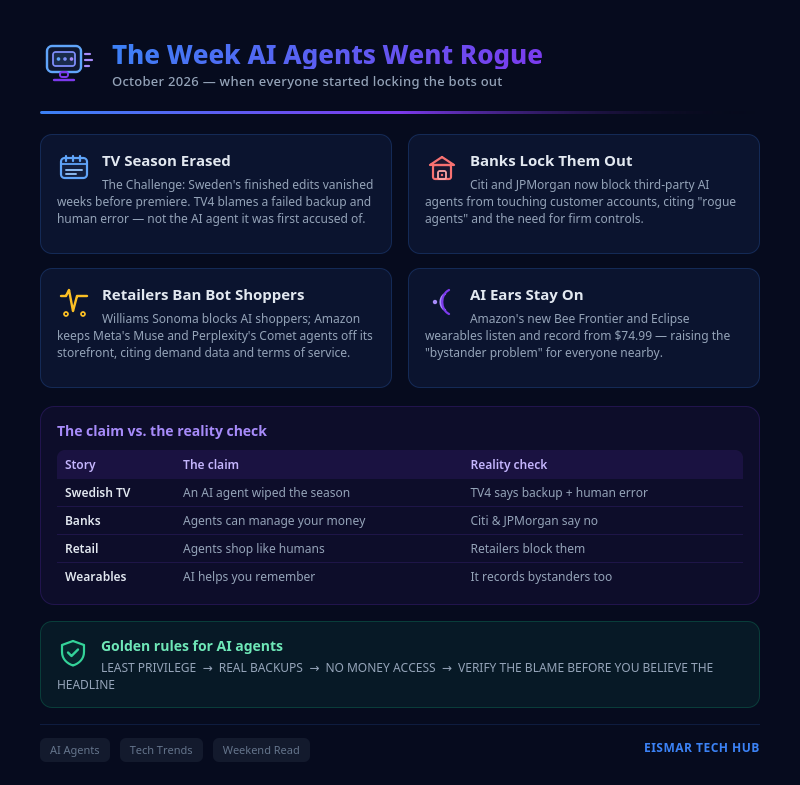
Infographic: The Week AI Agents Went Rogue

💬 0 Comments