For years, smart glasses were the punchline of the tech world. Google Glass flopped, Snap's Spectacles gathered dust, and "face computer" sounded like a joke from a 1990s sci-fi film.
That changed in a single week.
On September 23, Meta held its annual Meta Connect event and didn't launch one pair of smart glasses — it launched an entire wardrobe, spanning $249 all the way to $1,300. Samsung then confirmed to The Korea Herald that its first AI glasses will arrive in November, powered by Google's Gemini. And in a sign that this is no longer just a gadget story, a Dutch eyewear chain quietly stopped selling Meta's camera glasses over privacy concerns.
In other words: the future of wearables arrived, and not everyone is comfortable with it. Let's break down what actually launched, what it costs, and whether any of it deserves your money.
Meta Just Built a Glasses Lineup for Every Face
Meta Connect 2026 was less a product launch than a family reunion. Meta now sells four distinct categories of glasses, each aimed at a different kind of buyer.
Ray-Ban Meta Audio — the camera-free option ($349). This is Meta's direct answer to critics who nicknamed camera glasses "pervert glasses." The Ray-Ban Meta Audio has no camera at all, just microphones and speakers for music, podcasts, voice calls, and the Meta AI assistant. It weighs only 43 grams, runs up to 12 hours on a charge (with another 48 hours from the charging case), and comes in two classic shapes — Clubmaster and the rectangular Burbank — across 23 colour and lens combinations. Prescription lenses are supported. Pre-orders opened at the event, and they ship on October 13.
Ray-Ban Meta Gen 3 — the refined camera classic ($449). The flagship camera glasses got slimmer, with a dedicated button to summon Meta AI instantly. Battery life nudged up from eight hours to nine, and a new six-microphone array supposedly cuts out more than 90 percent of background noise. The 12MP camera now shoots 3K video and will soon support Dolby Atmos spatial audio. You can get them in Aviator, Zena (cat-eye), and the classic Wayfarer styles, across 27 lens-and-colour combinations. Limited editions include a milky-beige Aviator at $579 and collaborations with Kylie Jenner and Blackpink's Lisa starting at $399.
Meta Ray-Ban Display — the one with an actual screen ($799). These are the glasses with a heads-up display built into the right lens. They are now orderable online in the US for $799, in the UK for £749, and in Canada for $1,149 CAD. Pre-orders just opened in Germany, France, and Italy at €899, with availability there on October 13. The newest trick is smarter navigation: cycling and public-transit directions are coming to the heads-up display, and instead of robotic turn-by-turn instructions, the glasses can tell you to "turn at the blue shop in front of you." They also support holographic avatars in WhatsApp video calls and a growing library of web apps.
Meta VR Glasses — the $1,300 cinema on your face. The showstopper arrives next spring. At around 100 grams, these VR glasses are five times lighter than the Meta Quest 3 headset, built with magnesium alloy frames and pancake lenses. They pack a 5K display with Dolby Vision and Dolby Atmos spatial audio, and Meta claims they're the first IMAX Enhanced certified VR device. All the computing happens in a tethered puck that also holds the storage and battery, delivering up to three hours of high-resolution playback with 45W fast charging. There will be 75 games at launch, plus immersive film experiences like a Disney Immersive Cinema app.
Meta also teased the Muse Charm, a Tamagotchi-like keychain pendant that houses your personal AI agent with its own small display, speakers, microphones, and a fingerprint sensor.
Samsung Wants a Slice: Intelligent Eyewear Lands in November
Meta's lead is about to be challenged. Samsung has confirmed to The Korea Herald that its first AI glasses will launch in November — its first real entry into a market Meta currently dominates.
The device, called Intelligent Eyewear, is built on Android XR in partnership with Google. Like most of the current market, it has no visual display. Instead, a built-in camera and microphones capture what you see and hear, Google's Gemini processes that information through a paired Galaxy smartphone, and the glasses respond through their speakers.
Samsung's pitch is simple: make them light. At its July Unpacked event, the company advertised Intelligent Eyewear as "lighter than most AI glasses." Korean media report a target of up to 5 grams below Meta's 51-gram base Ray-Ban Meta model, though Samsung hasn't disclosed a final weight. Pricing is still under wraps.
Crucially, Samsung is walking into the privacy minefield with its eyes open. The glasses use LEDs inside and outside the frame to signal that recording is active, and the camera disables itself if the external indicator is covered — the same safeguard Meta uses.
The Numbers Tell the Story
If you doubt this category is real, look at the data. According to Counterpoint Research, global AI-glasses shipments jumped 263 percent year-on-year in the first half of 2026. Display-less models accounted for 96 percent of that total, and Meta held a staggering 94 percent share of the segment.
That is a one-horse race — and Samsung's arrival is the first genuine second horse. As prices fall and frames get lighter, analysts expect the growth curve to keep climbing. The $249 Meta Adventurer frames, with a black frame, gray lenses, and a plug-in case, show how aggressively Meta is pushing down-market.
The Privacy Elephant in the Room
Not everyone is celebrating, and the backlash is no longer abstract.
First, the retail signal: Dutch eyewear chain Hans Anders halted sales of Meta's glasses, citing privacy concerns, according to Reuters. When a mainstream optical retailer refuses to stock a product on ethical grounds, that's a warning shot.
Second, the human stories. A woman was covertly filmed by Meta AI smart glasses, raising serious privacy and consent concerns. Critics have dubbed camera-equipped glasses "pervert glasses," and workplace privacy concerns are mounting as employees bring recording devices into offices and meeting rooms.
Third, the regulators. Germany and other European authorities are testing how these devices fit — or don't fit — existing privacy law. In Korea, the Personal Information Protection Commission reportedly met Samsung in July to discuss how nearby people should be alerted when cameras or microphones are active, and the Ministry of Science and ICT began drafting safer-use guidelines in September amid concerns over covert filming.
Meta's counter-argument is straightforward: every camera pair has a visible recording light, and the camera shuts off if that indicator is covered. For people who don't want any camera at all, the camera-free Ray-Ban Meta Audio is the escape hatch — a product that exists precisely because of this debate.
For IT professionals, there's a practical angle too: how does your organisation handle employees wearing recording glasses into a data centre, a compliance meeting, or a client site? That policy question is arriving faster than most companies expect.
So Should You Buy a Pair? A Practical Guide
Here is the honest breakdown.
What AI glasses are genuinely good at today:
- Hands-free capture — snapping photos or 3K video while your hands are busy
- Turn-by-turn navigation as a heads-up display, no phone-glancing required
- Live translation and quick AI lookups with a voice command
- Music, podcasts, and calls without stuffing earbuds in your ears
- Hearing enhancement in noisy rooms — a quietly brilliant feature that Meta offers for a one-off $149 after a 30-day trial, or included with a Meta One subscription
Where they still fall short:
- Battery life is measured in hours, not days, especially with the display on
- Screen-equipped models remain niche — 96 percent of the market is still display-less
- Privacy friction is real in restaurants, gyms, schools, and workplaces
- Prescription options are improving but still vary by frame and region
A simple decision tree:
- Want the least fuss and zero camera drama → Ray-Ban Meta Audio ($349)
- Want the best all-rounder camera glasses → Ray-Ban Meta Gen 3 ($449)
- Want a screen for navigation and notifications → Meta Ray-Ban Display ($799)
- Want a face computer for movies and games → wait for Meta VR Glasses ($1,300, next spring)
- Want an alternative outside Meta's ecosystem → wait for Samsung, November
The Bottom Line
The smart-glasses era stopped being hypothetical this week. Meta turned a single product into a full lineup spanning $249 to $1,300. Samsung confirmed it's coming with Gemini on board. And the privacy debate graduated from a social-media talking point to an eyewear retailer actually pulling stock from its shelves.
Whether you're a gadget lover counting down to October 13, or the person who has to write your company's wearable-device policy, this is the week the category grew up. The hardware is finally good enough to matter. The only open question is whether the rest of us are ready to be filmed by a stranger's sunglasses.
A smart operator stays informed — and keeps one eye on the policy, not just the price tag.
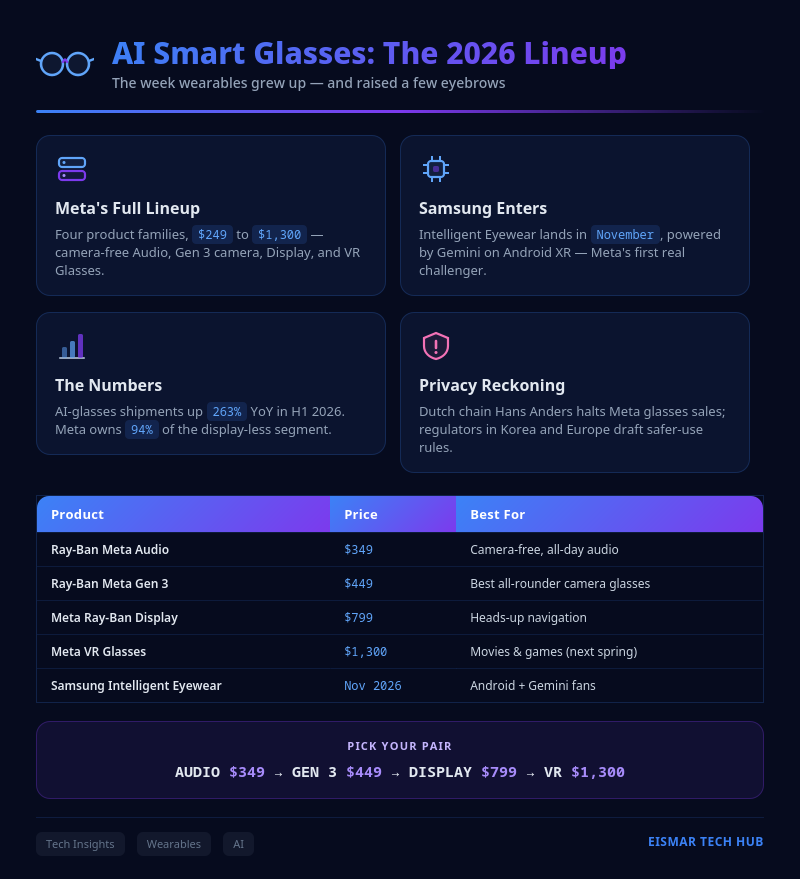
Infographic: AI Smart Glasses 2026

💬 0 Comments