Welcome to this week's IT Weekly Roundup — your curated snapshot of the biggest stories shaping technology globally and in Malaysia. From AI espionage at unprecedented scale to a chip architecture breakthrough that could redefine data center economics, here's what IT professionals need to know this week.
🔴 Anthropic Accuses Alibaba of Massive Claude Cloning Operation
In what might be the largest AI model theft campaign ever documented, Anthropic has disclosed new evidence linking Alibaba and its AI lab Qwen to an orchestrated effort to extract capabilities from the Claude family of models.
Between April 22 and June 5, Anthropic detected over 28.8 million exchanges with Claude generated through nearly 25,000 fraudulent accounts. The campaign specifically targeted Claude's most advanced features — agentic reasoning, software engineering capabilities, and long-horizon task execution — using obfuscation techniques and proxy networks to evade detection.
Anthropic wrote to Senators Tim Scott and Elizabeth Warren warning that a "growing circumvention economy" is fueling these distillation attacks, and urged Congress to update antitrust laws so AI firms can share threat intelligence on Chinese tactics without legal risk. The letter warned that unchecked distillation could effectively "turn hundreds of billions of dollars in American investment and R&D into a massive subsidy for our geopolitical competitors."
Why this matters: For IT leaders running AI-powered operations, this signals that API security and model access monitoring are no longer just compliance checkbox items — they're national security concerns that could reshape how AI vendors control access to frontier models.
🏛️ White House Asks OpenAI to Slow-Roll GPT 5.6
The Trump administration has quietly asked OpenAI to limit the release of its newest flagship model, GPT 5.6, to a select group of trusted partners rather than a public launch — marking a significant shift in the government's AI posture.
According to TechCrunch, CEO Sam Altman told staff at a meeting this week that the government would be "approving access customer by customer" during a preview period, with a broader release following in "a couple of weeks" if the controlled rollout goes well. The Office of the National Cyber Director and the Office of Science and Technology Policy were the agencies driving the request.
This follows Trump's earlier executive order directing AI companies to voluntarily submit new models for government testing before public release — and echoes Anthropic's own controlled release of its "Claude Mythos" frontier cyber model through the Project Glasswing program.
Why this matters: Government-mediated AI release schedules are becoming a new reality. IT leaders planning enterprise AI deployments should expect staggered access to frontier models and build flexible stacks that can swap providers or versions as availability shifts.
🛡️ Operation Endgame Takes Down Cybercrime Assembly Line
International law enforcement, Microsoft, and a coalition of private tech companies have struck a major blow against the cybercrime ecosystem — simultaneously disrupting two widely-used malware-as-a-service platforms in an operation called "Operation Endgame."
The first target, Amadey, is a malware-as-a-service platform active since 2018, used to compromise devices and deliver ransomware payloads. The second, StealC, is an infostealer-as-a-service platform that collects credentials, authentication cookies, cryptocurrency wallets, and files matching customer-defined patterns.
Microsoft's AI-driven analysis revealed that these two seemingly independent tools shared underlying infrastructure — enabling legal teams to seek a court order disrupting both simultaneously. The targeted organizations had collectively stolen more than $47 million through ransom payments and fraudulent schemes.
Why this matters: This operation demonstrates that AI-powered threat intelligence is now being used offensively against cybercriminal infrastructure at scale. IT security teams should take note: while impactful, takedowns like this often see replacement infrastructure emerge within weeks, so this is a breathing window, not a permanent fix.
🔬 IBM Unveils World's First Sub-1nm Chip Technology
IBM has announced a breakthrough that could reshape the economics of AI data centers for years to come: the world's first sub-1-nanometer chip architecture, dubbed the 0.7nm (7 angstrom) "nanostack" node.
The new design vertically stacks transistors in a staggered layout to overcome physical scaling limits, integrating nearly 100 billion transistors on a chip the size of a human fingernail — nearly double the density of IBM's previous generation. The company projects 50% higher computing performance or 70% greater energy efficiency compared to its 2nm node chips.
Critically for AI workloads, the nanostack design includes a 40% improvement in SRAM scaling through a staggered-channel design for bit cells — addressing a bottleneck where SRAM scaling had "fallen off drastically" in recent generations. IBM plans to commercialize the technology through partnerships with Samsung, targeting AI data center workloads first.
Why this matters: For IT professionals planning infrastructure, this signals that within the 2027–2028 timeframe, AI compute density could double without proportional increases in power and cooling — directly addressing the energy wall facing AI data center expansion.
🇲🇾 Malaysia's Tech Exports Hit Record Trade Surplus
Malaysia has posted a record trade surplus in the first five months of 2026, driven primarily by AI-led technology exports and energy sector growth. The nation's semiconductor and electronics sector — a critical node in the global chip supply chain — continues to benefit from the AI boom's insatiable demand for advanced packaging and test services.
Prime Minister Anwar Ibrahim has signaled Malaysia's readiness for a "next industrial leap" through partnerships with Japan in AI, digital transformation, and clean energy sectors. Meanwhile, The Edge Malaysia reports bargain-hunting has lifted Malaysian semiconductor stocks, though analysts warn momentum remains "wobbly" amid global trade uncertainties.
Malaysia is the world's sixth-largest semiconductor exporter and a major hub for chip assembly, testing, and packaging. Companies like Intel, Infineon, and AT&S have announced multi-billion-dollar manufacturing expansions in the country over the past two years.
Why this matters: For IT procurement and supply chain strategists, Malaysia's deepening semiconductor and AI infrastructure ecosystem signals reduced concentration risk away from Taiwan and China, and opens potential new options for data center capacity in the region.
That wraps up this week's IT Weekly Roundup. From AI model theft at unprecedented scale to sub-1nm chip breakthroughs and Malaysia's rise as a semiconductor powerhouse — the pace of change isn't slowing down. A smart operator stays informed. We'll be back next week with more insights.
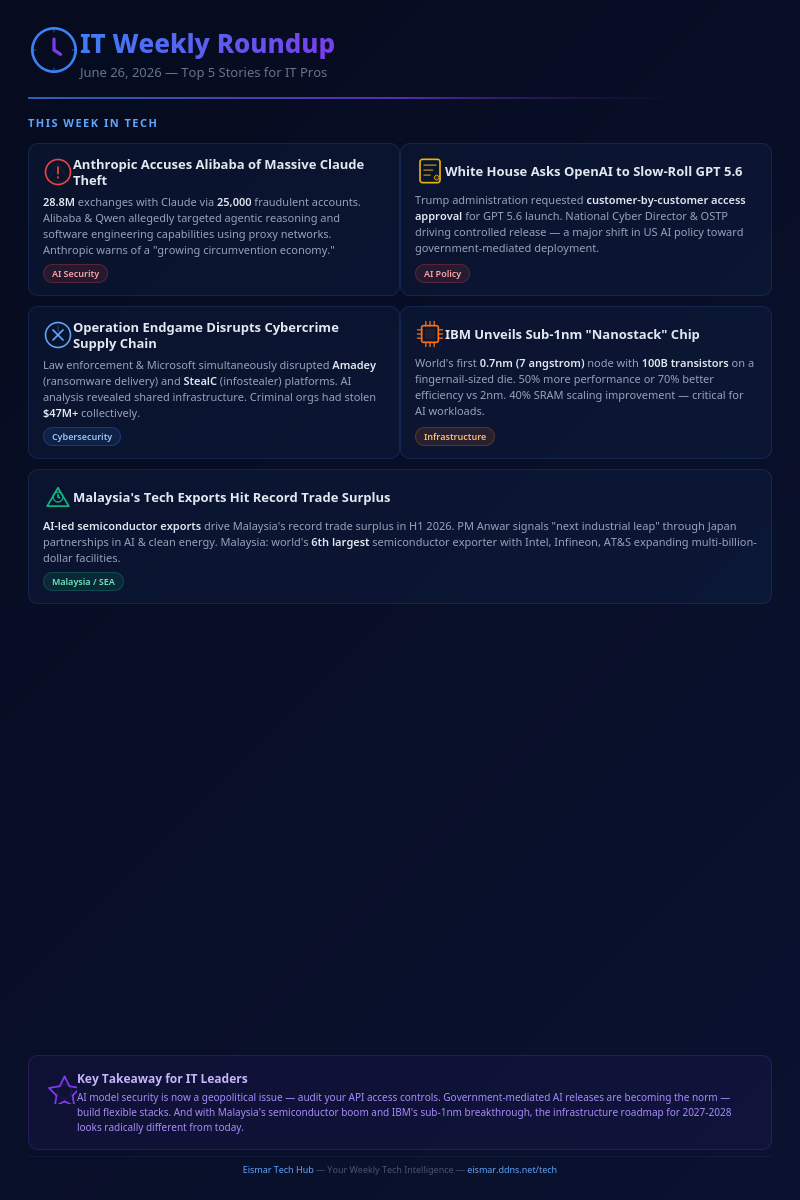
Infographic: IT Weekly Roundup

💬 0 Comments