The tech world doesn't slow down, and this past week — July 3 to 10, 2026 — was no exception. From Meta's ambitious pivot to in-house chip production to OpenAI's measured (but powerful) GPT-5.6 release, and Huawei's confirmed return to the Malaysian premium smartphone scene, there's plenty to unpack. We also saw Malaysia's tech sector getting a serious nod from analysts as AI and data centre demand continues to reshape the regional landscape. Let's dive in.
Meta to Begin Production of In-House AI Chip in September
Source: Reuters — July 9, 2026
An internal memo obtained by Reuters reveals that Meta plans to start production of its own custom AI chip — internally referred to as the "Meta Training and Inference Accelerator" (MTIA) — in September 2026. The social media giant aims to roughly double its computing capacity while reducing dependence on third-party suppliers like NVIDIA.
This is a big deal for a few reasons. Meta has been investing heavily in AI infrastructure, and its capex projections for 2026 have consistently exceeded Wall Street expectations. Building its own silicon gives Meta more control over its hardware roadmap, potentially lower costs at scale, and the ability to optimise chips specifically for its workloads — recommendation systems, content moderation, generative AI features across Facebook, Instagram, and WhatsApp.
The timing is also significant. September 2026 means TSMC's advanced packaging capacity — which is perpetually in high demand — will need to accommodate Meta alongside Apple, AMD, and NVIDIA. Industry watchers are closely watching whether Meta can secure enough CoWoS (Chip-on-Wafer-on-Substrate) capacity to make the MTIA ramp meaningful.
Why this matters: Meta joins a growing club of hyperscalers going vertical on silicon. Google (TPU), Amazon (Trainium/Inferentia), Microsoft (Maia), and now Meta are all moving away from pure dependency on NVIDIA's GPU supply chain. For Malaysia, this is particularly relevant — Penang and Kulim are home to some of the world's largest semiconductor assembly and testing facilities, including major OSAT players like ASE, Unisem, and Inari Amertron. As hyperscalers internalise chip design, the backend packaging and testing demand could either surge or shift. Malaysia's semiconductor ecosystem needs to stay nimble and continue investing in advanced packaging capabilities to capture this opportunity.
OpenAI Launches GPT-5.6 — "Frontier Intelligence That Scales"
Source: OpenAI, IBM Think — July 3–9, 2026
OpenAI quietly announced GPT-5.6 this week, branding it "Frontier intelligence that scales with your ambition." Despite the ambitious tagline, IBM's analysis notes the release is deliberately cautious compared to prior major version launches. The model features stronger "AI guardrails" around safety, content filtering, and enterprise compliance — a clear response to the regulatory scrutiny that has intensified since ChatGPT's debut.
Early benchmarks suggest GPT-5.6 significantly outperforms GPT-5 in reasoning, coding, and multilingual tasks. But the more interesting story is how it was released: with extensive documentation, safety evaluations, and a staged rollout. This marks a shift from the "move fast and ship" era of AI development to a more governance-first approach.
The release also comes amid an escalating copyright battle with US news outlets who are urging a federal judge to sanction OpenAI for alleged unauthorised use of copyrighted content in training data. This legal backdrop is shaping every major model release in 2026.
Why this matters: GPT-5.6 represents the new normal for frontier AI models — raw capability improvements are real and impressive, but they're being paired with deployment strategies that prioritise safety and compliance. For Malaysian developers and enterprises building on top of LLMs, this means more capable APIs but also potentially more restricted access and higher costs. It's a trade-off that every AI team will need to navigate.
EU Unveils Comprehensive Plan to Tackle AI-Driven Cybersecurity Threats
Source: European Commission — July 7, 2026
The European Commission published a comprehensive cybersecurity plan this week that specifically addresses both the risks and opportunities posed by advanced AI. The document is one of the first major policy frameworks to explicitly tackle AI-powered cyberattacks — including automated phishing campaigns, deepfake-enabled social engineering, and AI-augmented malware.
On the defensive side, the plan promotes AI-based threat detection, automated incident response, and cross-border intelligence sharing. It aligns with the broader EU AI Act enforcement framework, which is now moving from legislation to implementation with the AI Office operational and first compliance deadlines approaching.
Why this matters: Cybersecurity is an arms race, and AI is the latest escalation. Attackers are already using LLMs to write more convincing phishing emails, generate deepfake audio for vishing (voice phishing), and automate reconnaissance. Defenders need AI tools to keep pace. For Malaysian organisations, the EU's framework often serves as a benchmark — expect MCMC and MOSTI to take note as Malaysia develops its own cybersecurity and AI governance policies.
Huawei Pura 90 Series Confirmed for Malaysia Launch on July 14
Source: TechNave — July 7, 2026
Huawei has confirmed that its flagship Pura 90 series will officially launch in Malaysia on July 14, 2026. The lineup continues Huawei's post-Kirin revival, featuring its own HarmonyOS ecosystem and advanced camera technology developed entirely in-house — a significant achievement given ongoing US trade restrictions.
The Pura series (formerly the P series) has been Huawei's photography-focused flagship line. Early leaks suggest the Pura 90 will feature a revolutionary periscope zoom system and AI-powered computational photography that rivals — and in some scenarios, surpasses — the iPhone 17 Pro and Samsung Galaxy S26 Ultra.
Pricing and local carrier availability are expected to be announced at the July 14 launch event. Given Huawei's strong brand presence in Malaysia, particularly among tech enthusiasts and the Chinese diaspora community, the Pura 90 could carve out meaningful market share in the premium segment.
Why this matters: Huawei's return as a serious premium contender gives Malaysian consumers a genuine third option beyond Apple and Samsung. It also demonstrates that innovation can continue despite geopolitical headwinds — a lesson that resonates in Malaysia's own navigation of US-China tech tensions.
AI & Data Centre Demand Powers Malaysia's Tech Sector Outlook — Analysts Bullish on H2 2026
Source: TNGlobal, Maybank IB, Kenanga Research, TA Securities — July 9, 2026
Multiple top research houses have weighed in on Malaysia's tech sector outlook for the second half of 2026, and the verdict is overwhelmingly positive. Maybank Investment Bank, Kenanga Research, TA Securities, and MBSB all published notes this week highlighting AI and data centre demand as the "key growth driver" for Malaysia's technology sector.
Key takeaways from the analyst reports:
- Global semiconductor sales are projected to exceed US$1.5 trillion in 2026, approaching US$1.9 trillion in 2027, driven almost entirely by AI accelerator demand.
- New growth vectors: Photonics/optical transceivers, advanced cooling solutions (liquid cooling for data centres), and local advanced packaging capabilities are emerging as high-growth subsectors. Malaysian EMS providers like VS Industry and SKP Resources are well-positioned to capture portions of this value chain.
- Urban digitisation is being reframed from "Smart Cities" to "AI Cities" — a shift that reflects how AI is becoming the core enabler rather than an add-on. City councils in Kuala Lumpur, Johor Bahru, and Penang are exploring AI-driven traffic management, waste optimisation, and public safety systems.
- Data centre buildout acceleration: Johor alone has attracted over RM 50 billion in committed data centre investments since 2024, with major players like AirTrunk, Bridge Data Centres, GDS Holdings, and Yondr Group setting up facilities. The rush is straining grid capacity but also catalysing Malaysia's renewable energy push.
- Risks to watch: Memory shortages (HBM supply remains tight), US tariff uncertainties (potential escalation post-US elections could impact Malaysian semiconductor exports), and forex exposure for companies with USD-denominated revenue.
The analyst consensus is that Malaysia is uniquely positioned to benefit from the global AI infrastructure buildout. With new data centre investments flooding into Johor (Sedili, Kulai, Iskandar Puteri), Selangor (Cyberjaya, Elmina), and Sarawak (Kuching, Bintulu), the country is rapidly becoming a Southeast Asian AI infrastructure hub.
Why this matters: For anyone in Malaysia's tech industry — whether you're in semiconductor fabrication, data centre operations, software development, or IT services — the H2 2026 outlook is genuinely promising. The AI supercycle is not just a Silicon Valley story anymore. It's creating real economic opportunities in Malaysia, from high-skilled jobs to infrastructure investments.
Conclusion
It's been a packed week in tech. Meta is doubling down on silicon independence, OpenAI is shipping smarter (and safer) models, the EU is getting serious about AI-powered cyber threats, Huawei is making a comeback in Malaysia, and the country's own tech sector is riding the AI wave with strong analyst backing.
Whether you're an IT professional watching the infrastructure buildout, a developer trying to keep up with the latest AI models, or just someone who follows tech news, there's a lot to digest here. The key takeaway? The AI era is no longer coming — it's here, and it's reshaping everything from chip design to national economic policy.
Stay tuned for next week's roundup. There's always more happening in the world of tech.
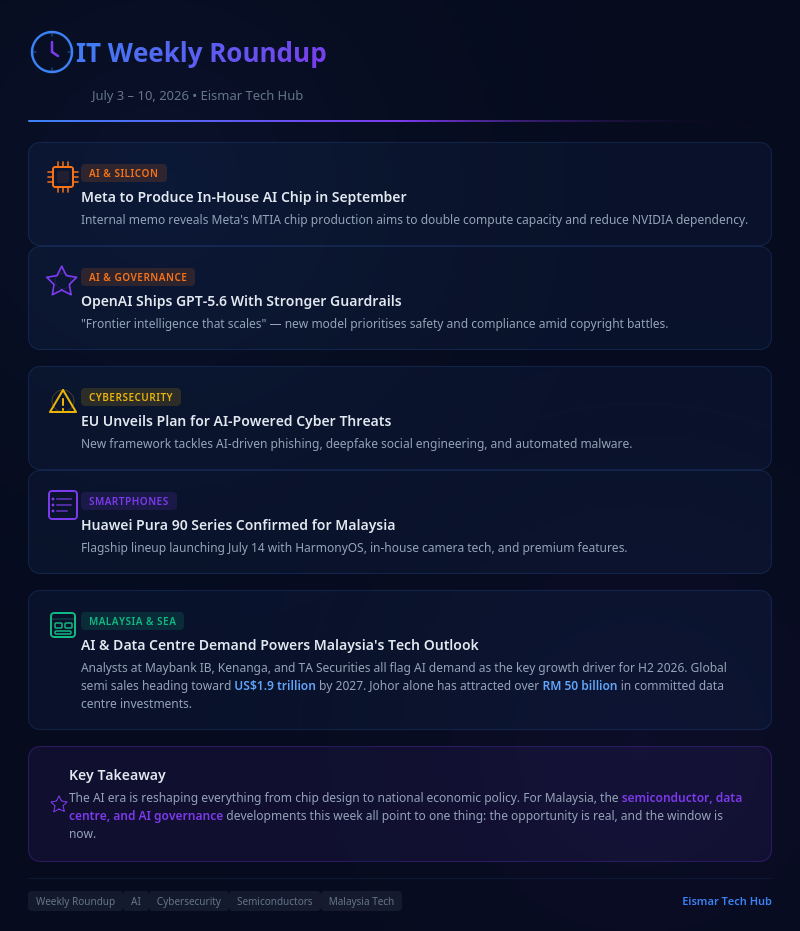
Infographic: IT Weekly Roundup July 10 2026

💬 0 Comments