July 10, 2026 — This week in tech: OpenAI releases GPT-5.6 with government oversight, Meta enters the AI coding market, Palo Alto's CEO calls for 90% price drop, Microsoft's emissions rise, and Malaysia lands a strategic rare-earth magnet factory.
1. OpenAI Launches GPT-5.6 Family — 54% More Token Efficient
OpenAI CEO Sam Altman announced the release of GPT-5.6, a family of three model variants — Sol, Terra, and Luna — on Thursday, July 9. The models are 54% more token efficient on agentic coding tasks compared to their predecessors.
What's notable is the government collaboration angle: Altman told CNBC that OpenAI worked with Commerce Secretary Howard Lutnick, Treasury Secretary Scott Bessent, and U.S. National Cyber Director Sean Cairncross on the approval process. A "small group of trusted partners" had early access at the request of the U.S. government before the broad public release.
> "Every enterprise now is thinking about spend and the value they're getting in exchange for AI, and this is what we really want to do." — Sam Altman
OpenAI is currently valued at $852 billion by private investors.
Why this matters: GPT-5.6 sets a new precedent for AI regulation with explicit government collaboration on safety. The 54% token efficiency gain directly addresses the enterprise cost pain point dominating AI discourse this week — and signals that frontier labs are listening to the pricing backlash.
2. Meta Jumps into AI Coding Market with Muse Spark 1.1
Meta unveiled Muse Spark 1.1, its "strongest model for agentic and coding work yet," per AI Chief Alexandr Wang. The API is priced at $1.25/M input tokens and $4.25/M output tokens, with $20 free credits for new accounts.
Wang characterized the pricing as "very aggressive and attractive" versus Anthropic and OpenAI. This is Meta's second major Muse release this week — Muse Image (codenamed Mango) launched on Tuesday for image generation targeting creators and advertisers.
> "The goal is to really have attractive pricing that scales with immense consumption usage." — Alexandr Wang, Meta AI Chief
Why this matters: Meta is aggressively pivoting to monetize AI after pressure from Wall Street to show ROI on massive infrastructure spending. Its aggressive pricing could trigger a price war that makes AI coding tools far more accessible to enterprises — good news for IT teams watching their AI budgets.
3. Palo Alto CEO: AI Token Costs Must Fall 90%
Nikesh Arora, CEO of Palo Alto Networks, told CNBC that AI token costs need to drop as much as 90% to promote large-scale enterprise adoption. He called for token efficiency improvements to reach roughly 20% of current costs within 12 months and 10% the following year.
Responding to OpenAI's 54% efficiency claim in GPT-5.6, Arora said: "I think 54% is a good start... I think we probably need another turn at it."
Arora joins a growing chorus — including Palantir CEO Alex Karp — calling out the token pricing model as a barrier to enterprise AI adoption.
Why this matters: The CEO of the world's largest cybersecurity firm is publicly calling for an AI pricing revolution. This signals that even security budgets can't absorb current AI costs, and the token pricing model is becoming a systemic bottleneck for enterprise AI adoption across all sectors.
4. Microsoft's Carbon Emissions Rose 25% Amid AI Infrastructure Expansion
Microsoft released its annual sustainability report on Friday showing a 25% increase in carbon emissions last year. The company acknowledged that sustainability solutions "aren't keeping up with AI demands."
The report comes amid Microsoft's massive data center buildout to support AI workloads, including its partnership with OpenAI and Copilot infrastructure. Despite pledging to be carbon-negative by 2030, the company's AI expansion is making that target increasingly difficult to reach.
Why this matters: As Big Tech races to build AI infrastructure, the environmental cost is becoming impossible to ignore. Microsoft's own data shows its AI ambitions are directly at odds with its climate pledges — a tension every IT leader should watch as AI deployment scales in their own organizations.
5. Lynas Partners JS Link for Rare-Earth Magnet Factory in Kuantan
Australia's Lynas Rare Earths partnered with South Korea's JS Link to build a rare-earth magnet factory in Kuantan, Malaysia. The facility will produce 3,000 tonnes of magnets per annum and is expected to create up to 400 jobs.
The factory positions Malaysia as a key node in the global rare-earth supply chain — critical for EV motors, wind turbines, and defense hardware. This diversifies supply away from China's dominant position in rare-earth processing.
Why this matters: Malaysia is becoming a strategic manufacturing hub for the global energy transition and AI infrastructure supply chain. This factory moves rare-earth magnet production closer to Southeast Asian assembly lines and strengthens Malaysia's position in the global tech supply chain.
6. Anthropic Appoints Former Fed Chair Ben Bernanke to AI Governance Trust
Anthropic appointed Ben Bernanke, former Federal Reserve Chair (2006–2014) and Nobel Prize winner in economics, to its Long-Term Benefit Trust — the independent governance body that advises the company and appoints board members.
Bernanke is the fourth member, joining Neil Buddy Shah, Richard Fontaine, and Mariano-Florentino Cuéllar. Members hold no equity in Anthropic and are paid only for their time. Anthropic is valued at $965 billion and is reportedly gearing up for a potential IPO.
> "Anthropic has created a unique governance structure to try to ensure that the long-run benefits of AI for humanity far outweigh the risks." — Ben Bernanke
Why this matters: A former Fed Chair joining an AI company's trust signals that AI governance is going mainstream — and that Anthropic is serious about its "long-term benefit" structure as a differentiator ahead of its IPO. This unique governance model may be emulated by other AI labs facing regulatory scrutiny.
Closing Thoughts
This week was dominated by AI pricing and governance — from OpenAI's government-collaborated GPT-5.6 release to Meta's aggressive market entry with Muse Spark, and the growing chorus of enterprise leaders calling for a pricing revolution. On the infrastructure side, Microsoft's rising emissions remind us that AI's environmental footprint is still an unsolved problem, while Malaysia's rare-earth factory highlights the shifting geography of the global tech supply chain.
Stay tuned for next week's roundup — and as always, a smart operator makes informed decisions.
Eismar Tech Hub — July 10, 2026
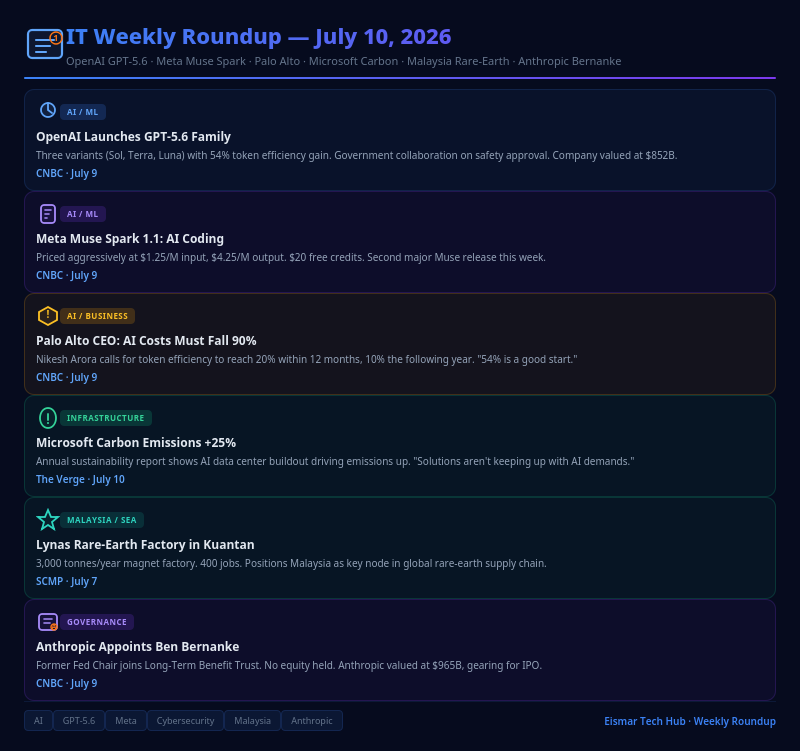
Infographic: IT Weekly Roundup July 10

💬 0 Comments