June 2026 has been a watershed month for enterprise AI. Two developments — the launch of the Agentic Resource Discovery (ARD) standard and the Pentagon confirming 1.5 million personnel using generative AI tools — signal that agentic AI has moved from experimental to operational. For IT leaders and system administrators, the question is no longer if autonomous AI agents will reshape enterprise infrastructure, but how quickly you need to adapt.
🔍 The ARD Standard: A "Search Engine for AI Agents"
On June 18, a consortium of 11 tech giants — including Google, Microsoft, NVIDIA, Salesforce, GitHub, Hugging Face, and Cisco — announced the Agentic Resource Discovery (ARD) standard. Published under the Apache 2.0 license, ARD creates an open specification for AI agents to discover and use tools, skills, and other agents across the web.
Think of it as DNS for the agentic web. Domains host `ai-catalog.json` files — similar to `robots.txt` — that describe available AI capabilities. Registries crawl these files, making them discoverable by agents at runtime. GitHub has already launched Agent Finder (built on ARD), letting Copilot discover MCP servers, skills, and tools dynamically. Hugging Face followed with a Discover Tool offering semantic search over thousands of Skills and MCP Servers.
Notable absentees: OpenAI and Anthropic did not join the consortium, creating a potential divide in the agent ecosystem.
🏛️ Pentagon-Scale AI: 1.5 Million Users & Counting
The Pentagon's Chief Technology Officer Emil Michael revealed that all six military branches now use generative AI through the GenAI.mil platform (powered by Google Cloud's Gemini for Government, launched December 2025). Usage statistics are striking:
- 200 staff-hours of manual congressional report drafting reduced to 5 hours using AI
- Over 1,400 congressionally mandated reports now leverage AI assistance
- 1.5 million personnel actively using GenAI tools across the Department of Defense
However, the rush to AI has cautionary tales. KPMG recently published a report with "numerous AI-generated errors and false claims" — a reminder that AI agents require human oversight, especially in high-stakes environments.
⚡ Implications for Enterprise IT Infrastructure
The shift to autonomous AI agents carries specific infrastructure implications for IT teams:
1. API Management at Scale: ARD means thousands of discoverable AI endpoints. IT teams need robust API gateways with rate limiting, authentication, and monitoring to handle agent-to-agent traffic.
2. Security Boundaries: Agentic AI introduces new attack surfaces — prompt injection across agent chains, unauthorized tool discovery, and data leakage through agent outputs. Zero-trust architectures must extend to AI agents.
3. Compute Planning: Local inference for latency-sensitive agents vs. cloud for heavy workloads. The hybrid approach (small models locally, large models in cloud) is becoming standard.
4. Governance & Compliance: With the Pentagon's scale and KPMG's incident as case studies, organizations need AI governance frameworks that include audit trails, human-in-the-loop approvals, and output validation.
💡 Conclusion
The ARD standard and Pentagon-scale adoption mark a clear inflection point. Agentic AI is no longer a lab experiment — it's entering production environments at an unprecedented pace. For IT leaders, the window to build the infrastructure, security, and governance foundations is closing fast. The agents are coming. Make sure your network is ready.
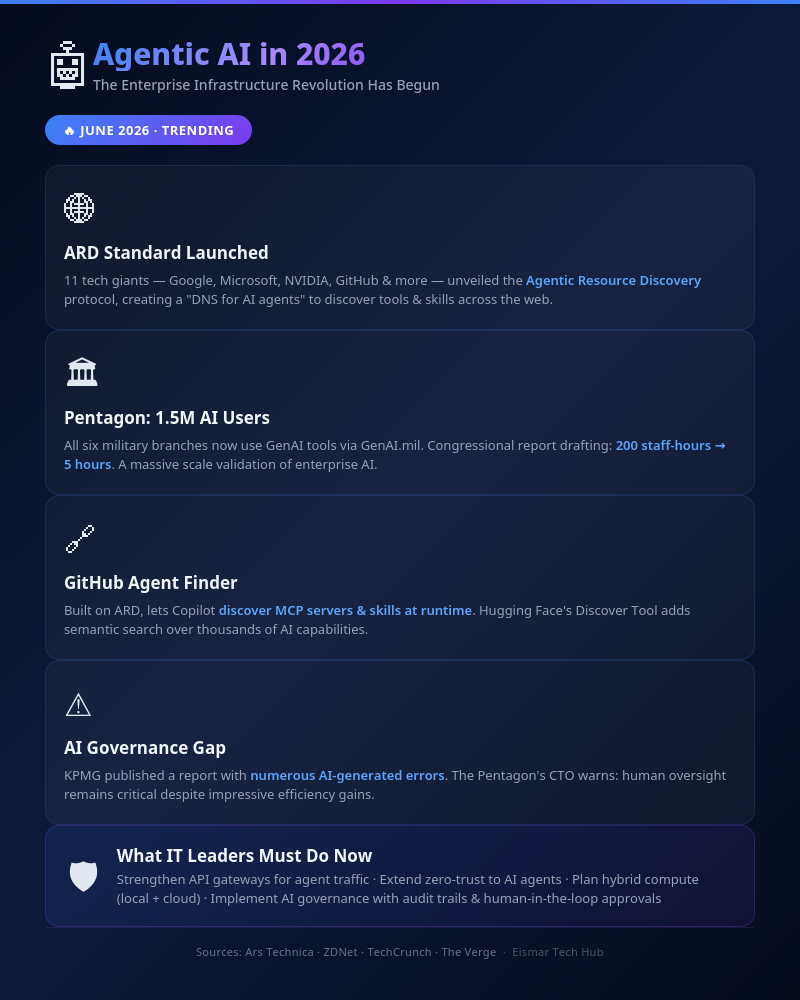
Infographic: Agentic AI 2026

💬 0 Comments