Introduction
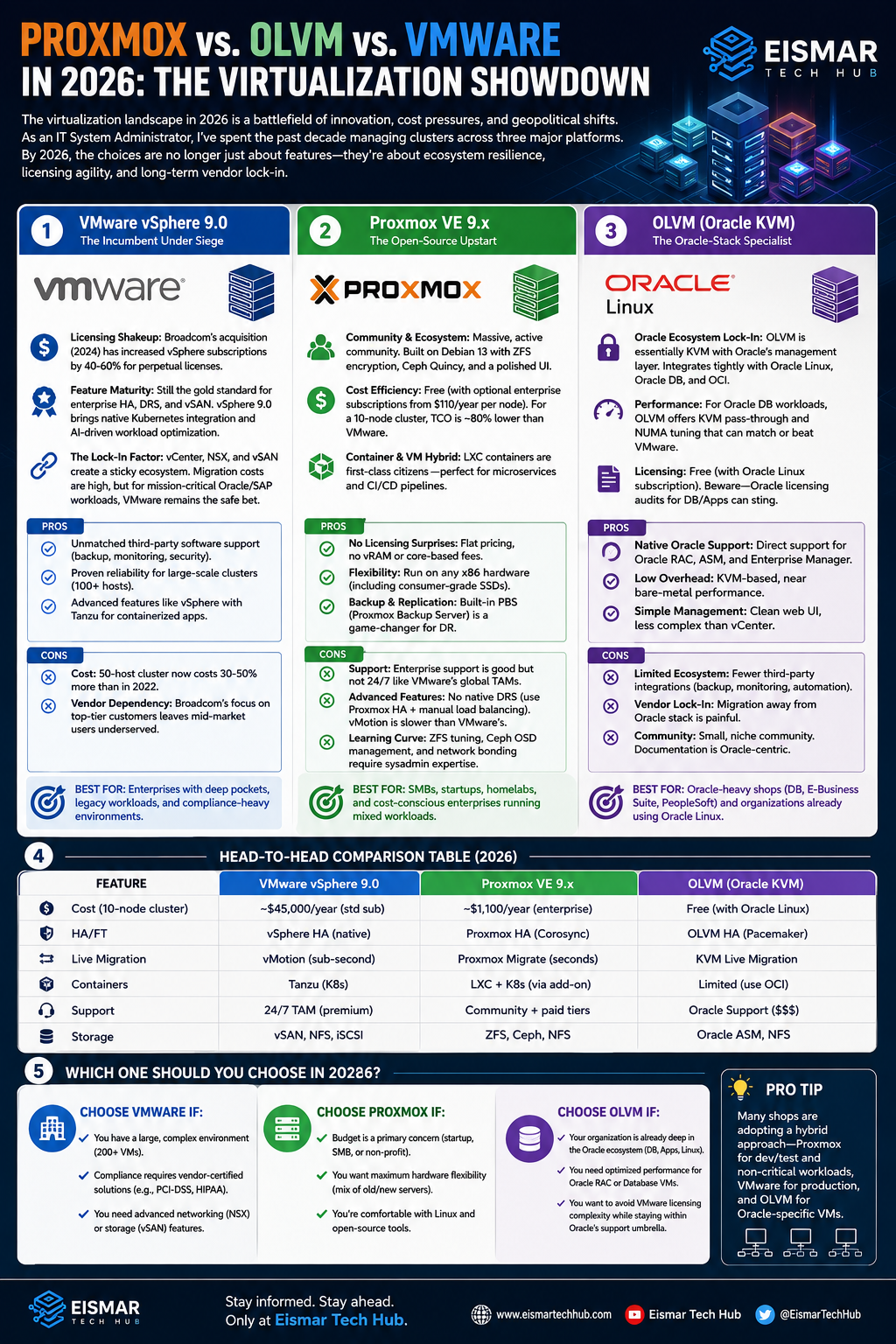
The virtualization landscape in 2026 is a battlefield of innovation, cost pressures, and geopolitical shifts. As an IT System Administrator, I’ve spent the past decade managing clusters across three major platforms: Proxmox VE, Oracle Linux Virtualization Manager (OLVM), and VMware vSphere. By 2026, the choices are no longer just about features—they’re about ecosystem resilience, licensing agility, and long-term vendor lock-in. Let’s dive into the hard truths, benchmarks, and real-world scenarios for each platform.
---
1. VMware vSphere: The Incumbent Under Siege
Key Points:
- Licensing Shakeup: Broadcom’s acquisition of VMware (finalized in 2024) has dramatically altered pricing. By 2026, vSphere subscriptions have risen 40-60% for perpetual licenses, pushing many SMBs toward alternatives.
- Feature Maturity: Still the gold standard for enterprise HA, DRS, and vSAN. The 2026 release (vSphere 9.0) introduces native Kubernetes integration and AI-driven workload optimization.
- The Lock-In Factor: vCenter, NSX, and vSAN create a sticky ecosystem. Migration costs are high, but for mission-critical Oracle/SAP workloads, VMware remains the safe bet.
Pros:
- Unmatched third-party software support (backup, monitoring, security).
- Proven reliability for large-scale clusters (100+ hosts).
- Advanced features like vSphere with Tanzu for containerized apps.
Cons:
- Cost: A 50-host cluster now costs 30-50% more than in 2022.
- Vendor Dependency: Broadcom’s focus on top-tier customers leaves mid-market users underserved.
Best for: Enterprises with deep pockets, legacy workloads, and compliance-heavy environments.
---
2. Proxmox VE: The Open-Source Upstart
Key Points:
- Community & Ecosystem: By 2026, Proxmox has a massive, active community. The Proxmox VE 9.x release (based on Debian 13) offers ZFS native encryption, Ceph Quincy integration, and a polished web UI.
- Cost Efficiency: Free (with optional enterprise subscriptions starting at $110/year per node). For a 10-node cluster, total TCO is 80% lower than VMware.
- Container & VM Hybrid: LXC containers are first-class citizens—perfect for microservices and CI/CD pipelines.
Pros:
- No Licensing Surprises: Flat pricing, no vRAM or core-based fees.
- Flexibility: Run on any x86 hardware (including consumer-grade SSDs).
- Backup & Replication: Built-in PBS (Proxmox Backup Server) is a game-changer for DR.
Cons:
- Support: Enterprise support is good but not 24/7 like VMware’s global TAMs.
- Advanced Features: No native DRS (use Proxmox HA + manual load balancing). vMotion is slower than VMware’s.
- Learning Curve: ZFS tuning, Ceph OSD management, and network bonding require sysadmin expertise.
Best for: SMBs, startups, homelabs, and cost-conscious enterprises running mixed workloads.
---
3. OLVM (Oracle Linux Virtualization Manager): The Oracle-Stack Specialist
Key Points:
- Oracle Ecosystem Lock-In: OLVM is essentially KVM with Oracle’s management layer. It tightly integrates with Oracle Linux, Oracle Database, and Oracle Cloud Infrastructure (OCI).
- Performance: For Oracle DB workloads, OLVM offers KVM pass-through and NUMA tuning that can match or beat VMware.
- Licensing: Free (with Oracle Linux subscription). But beware—Oracle’s licensing audits for DB/Apps can sting if you’re not careful.
Pros:
- Native Oracle Support: Direct support for Oracle RAC, ASM, and Enterprise Manager.
- Low Overhead: KVM-based, so you get near-bare-metal performance for compute-intensive tasks.
- Simple Management: Web UI is clean, but less feature-rich than vCenter.
Cons:
- Limited Ecosystem: Fewer third-party integrations (backup, monitoring, automation).
- Vendor Lock-In: Migration away from Oracle stack is painful—you’re tied to Oracle Linux guests and storage.
- Community: Small, niche community. Documentation is Oracle-centric.
Best for: Oracle-heavy shops (DB, E-Business Suite, PeopleSoft) and organizations already using Oracle Linux.
---
4. Head-to-Head Comparison Table (2026)
| Feature | VMware vSphere 9.0 | Proxmox VE 9.x | OLVM (Oracle KVM) |
|---|---|---|---|
| Cost (10-node cluster) | ~$45,000/year (std sub) | ~$1,100/year (enterprise) | Free (with Oracle Linux) |
| HA/FT | vSphere HA (native) | Proxmox HA (Corosync) | OLVM HA (Pacemaker) |
| Live Migration | vMotion (sub-second) | Proxmox Migrate (seconds) | KVM Live Migration |
| Containers | Tanzu (K8s) | LXC + K8s (via add-on) | Limited (use OCI) |
| Support | 24/7 TAM (premium) | Community + paid tiers | Oracle Support ($$$) |
| Storage | vSAN, NFS, iSCSI | ZFS, Ceph, NFS | Oracle ASM, NFS |
---
5. Which One Should You Choose in 2026?
Decision Matrix:
- Choose VMware if:
- You have a large, complex environment (200+ VMs).
- Compliance requires vendor-certified solutions (e.g., PCI-DSS, HIPAA).
- You need advanced networking (NSX) or storage (vSAN) features.
- Choose Proxmox if:
- Budget is a primary concern (startup, SMB, or non-profit).
- You want maximum hardware flexibility (mix of old/new servers).
- You’re comfortable with Linux and open-source tools.
- Choose OLVM if:
- Your organization is already deep in the Oracle ecosystem (DB, Apps, Linux).
- You need optimized performance for Oracle RAC or Database VMs.
- You want to avoid VMware licensing complexity while staying within Oracle’s support umbrella.
Pro Tip: Many shops are adopting a hybrid approach—Proxmox for dev/test and non-critical workloads, VMware for production, and OLVM for Oracle-specific VMs.
---
Conclusion: The Future Is Fragmented
In 2026, there is no one-size-fits-all virtualization platform. VMware remains the enterprise fortress, but its cost trajectory is pushing organizations to re-evaluate. Proxmox has matured into a credible alternative for the majority of workloads, with a vibrant community and rock-solid Linux foundation. OLVM serves a specific, valuable niche for Oracle-centric environments.
My advice: Don’t bet on a single platform. Build skills across all three, and design your infrastructure to be portable. The next wave of virtualization innovation may come from unexpected places—like Red Hat’s OpenShift Virtualization or Microsoft’s Azure Stack HCI. But for now, these three are the pillars of 2026’s virtualized world.
What’s your experience? Drop a comment below if you’ve migrated between these platforms—I’d love to hear your war stories.
---
Follow me for more deep dives into IT infrastructure, automation, and the latest in virtualization.

💬 0 Comments