Every network has a front door. Whether you're running a two-person startup or a multi-site enterprise, the device standing guard is your firewall. But not all firewalls inspect traffic the same way. If you've ever wondered why some firewalls can "remember" a connection while others treat every packet like a stranger, you're about to find out.
Let's break down the two fundamental approaches to firewall filtering — stateful and stateless — and when to use each.
What Is a Stateless Firewall?
A stateless firewall (also called a packet filter) examines each packet in isolation. It doesn't keep track of connections — it simply checks headers (source IP, destination IP, port, protocol) and decides: allow or deny.
Think of it like a bouncer who only checks your ID at the door. Once you're in, he has no idea whether you've already been inside or what you're doing there. Every time you try to move to a different room, he checks your ID again.
How Stateless Rules Work
Stateless rules use access control lists (ACLs):
- Source IP: `192.168.1.0/24`
- Destination IP: `10.0.0.0/8`
- Destination Port: `443 (HTTPS)`
- Action: Allow
If a packet matches, it passes. If not, it's dropped. Simple, fast, and predictable.
Pros and Cons
Pros:
- Extremely fast — no connection tracking overhead
- Simple to configure and understand
- Low memory footprint — ideal for high-throughput environments like core routers
- Resistant to certain state-exhaustion attacks
Cons:
- Cannot understand traffic context — a reply packet from a legitimate server looks identical to an unsolicited malicious packet
- Requires explicit rules for return traffic (e.g., you must allow `10.0.0.0/8 → 192.168.1.0/24` on high ports)
- No inspection of application-layer data
- Rule sets can become bloated trying to cover all possible return paths
What Is a Stateful Firewall?
A stateful firewall tracks the state of every active connection. When an internal host initiates an outbound connection, the firewall creates a state table entry. Return packets matching that entry are automatically allowed — no rule required.
This bouncer keeps a guest list. Once your ID is verified at the door, your name goes on the list. You can move between rooms freely until you leave. Anyone whose name isn't on the list gets stopped.
How Stateful Tracking Works
The firewall maintains a state table tracking:
- Source/destination IPs
- Source/destination ports
- Connection state (SYN, SYN-ACK, ESTABLISHED, FIN, CLOSED)
- Sequence numbers (for TCP)
- Protocol-specific state (for UDP, ICMP)
When a reply packet arrives, the firewall checks the state table. If it matches an existing entry, it passes without consulting the rule base. This is why stateful firewalls can allow return traffic with a single outbound rule — no explicit inbound rules needed for replies.
Pros and Cons
Pros:
- Context-aware — understands flow of traffic, not just individual packets
- Fewer rules needed — automatic return traffic handling
- Can detect protocol anomalies (e.g., ACK packets without SYN)
- Typically includes application-layer inspection capabilities (IPS, DPI)
- Better security posture — blocks unsolicited inbound traffic by default
Cons:
- Higher resource usage — state table consumes memory and CPU
- Potential state-table exhaustion under high load or DDoS attacks
- Slightly higher latency per packet (state lookup + rule check)
- More complex to troubleshoot — stale entries, asymmetric routing can cause issues
- Can be vulnerable to state-table floods if not properly sized
Stateful vs Stateless: Head-to-Head
| Feature | Stateless Firewall | Stateful Firewall |
|---|---|---|
| Inspection depth | Layer 3-4 (IP, Port, Protocol) | Layer 3-7 (up to Application) |
| Connection tracking | No | Yes — state table |
| Performance | Very high (hardware-fast) | Moderate to high (CPU-bound) |
| Rule complexity | Many rules (return traffic needs explicit allow) | Fewer rules (auto-return) |
| Security level | Basic — IP/port filtering only | High — understands context |
| Typical location | Core routers, edge of large networks | Network perimeter, DMZ, internal segments |
| Memory usage | Very low | Moderate to high |
| Attack resilience | Excellent against state-table attacks | Needs protection from SYN floods |
When to Use Which
Use Stateless When:
- You need maximum throughput on core network infrastructure
- Traffic is simple and predictable (e.g., static routing between known subnets)
- Hardware resources are limited
- You're filtering at line rate on a router or switch
Use Stateful When:
- Your network connects to the internet and needs real security
- You want default-deny inbound with automatic return traffic handling
- You need application-layer inspection (IDS/IPS, content filtering)
- You're implementing a DMZ, site-to-site VPN, or remote access solution
Modern Reality: The Best of Both Worlds
Today's enterprise firewalls are almost always stateful — but they also include stateless packet-filtering capabilities for specific use cases. Modern next-generation firewalls (NGFWs) combine:
- Stateful inspection for connection tracking
- Stateless ACLs for high-throughput filtering
- Deep packet inspection (DPI) for application awareness
- Intrusion prevention (IPS) for threat detection
For most environments, a stateful firewall at the perimeter backed by stateless ACLs on internal routers is the gold standard.
Key Takeaways
- Stateless firewalls inspect packets one at a time — fast but blind to context
- Stateful firewalls track connections — smarter but hungrier
- Return traffic is the biggest practical difference: stateless needs explicit rules, stateful handles it automatically
- NGFWs combine both approaches with application-layer inspection
- For internet-facing environments, always use a stateful firewall
- For internal high-throughput filtering between trusted segments, stateless ACLs are still the right tool
When someone asks you, "Stateful or stateless?", the real answer isn't one or the other — it's understanding when each one belongs in your network stack.
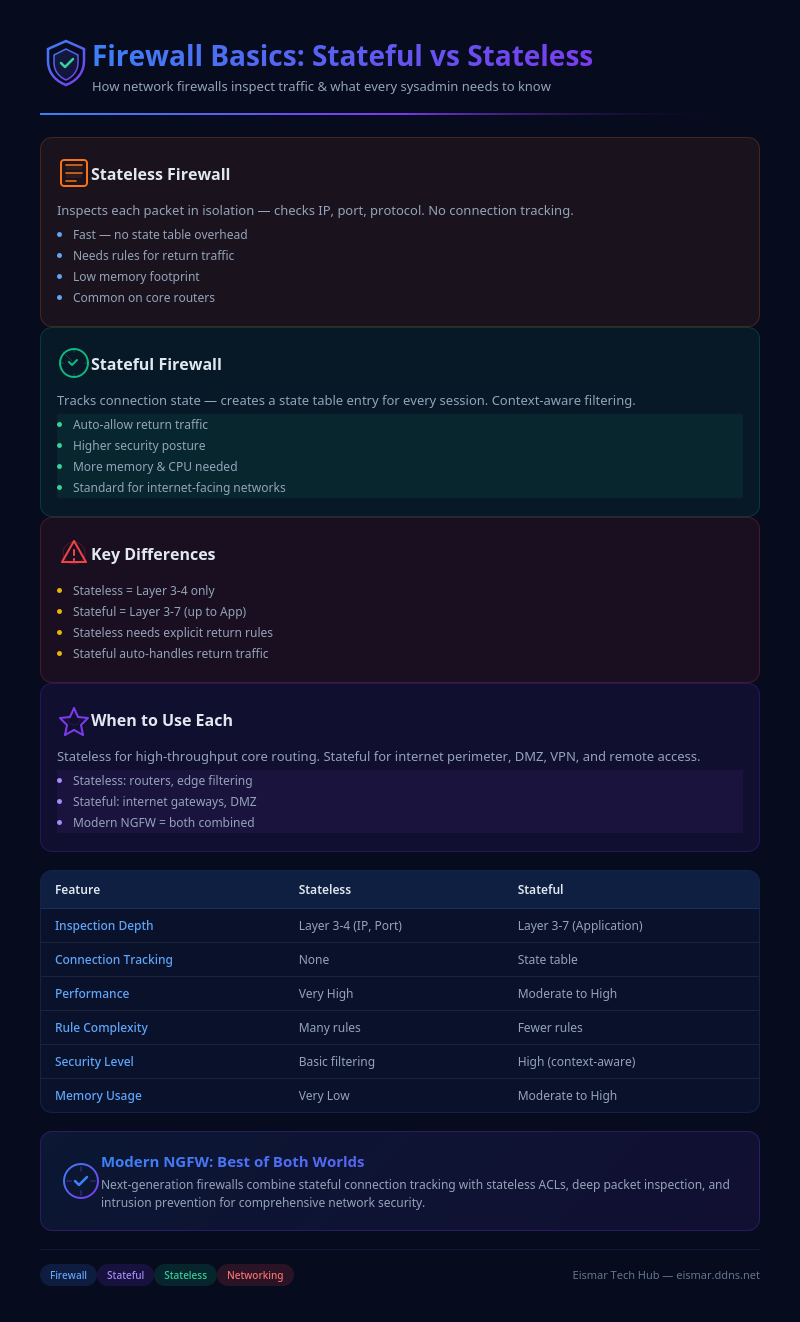
Firewall Basics: Stateful vs Stateless

💬 0 Comments