Welcome to this week's IT Weekly Roundup — your curated snapshot of the biggest stories shaping technology globally and in Malaysia for the week of June 27 to July 3, 2026. From a massive Microsoft AI deployment gambit to a long-overdue reality check on AI agents from Meta's CEO, and a homegrown semiconductor push from Malaysia, here's what IT professionals need to know.
🏢 Microsoft Launches $2.5 Billion Frontier Company for Enterprise AI Deployments
On Thursday, July 2, Microsoft announced the creation of Microsoft Frontier Company, a new operating business dedicated exclusively to delivering enterprise AI deployments at scale. The venture comes with a $2.5 billion commitment from Microsoft and will be staffed by 6,000 industry and engineering experts.
Microsoft's Commercial Business CEO Judson Althoff described the initiative in sweeping terms: "This goes beyond what has been labeled as Forward-Deployed Engineering, and will be the largest, most capable, outcome-driven engineering organization in the industry."
The timing is telling. Just two days earlier, Amazon Web Services announced a $1 billion internal commitment for its own AI deployment venture. Both OpenAI and Anthropic have also launched similar joint ventures with enterprise partners. The message is clear: the AI platform wars are shifting from "who has the best model" to "who can actually deploy it in the enterprise."
Why this matters: For IT professionals, this signals a massive wave of AI transformation projects headed your way. Microsoft's Frontier Company will embed dedicated deployment engineers at Fortune 500 clients, meaning IT teams will need to coordinate closely on integration, security, governance, and compliance. If you're an IT leader, now is the time to start thinking about your organization's AI readiness — because Microsoft is coming with 6,000 engineers ready to deploy.
✅ Source: TechCrunch — Russell Brandom (July 2, 2026)
🐘 Zuckerberg Admits AI Agents Haven't Progressed as Fast as Hoped
In a striking moment of candor, Meta CEO Mark Zuckerberg told staff at an internal town hall on Thursday that the pace of AI agent development had not "accelerated in the way" executives had previously expected.
The admission comes after Meta laid off approximately 8,000 employees (10% of its corporate workforce) earlier this year and reassigned another 7,000 to AI groups — including one called "Agent Transformation." Zuckerberg acknowledged the layoffs were not as "clean" as they should have been, and that the perceived upside of the new AI-focused structure hadn't "come to fruition yet."
Meta expects to see improvements from its AI investments in the next 3 to 6 months — but this is the same company that plans to spend up to $145 billion on AI infrastructure this year alone, per Reuters.
Why this matters: This is a healthy dose of realism from one of the biggest AI spenders on the planet. If Meta — with nearly infinite resources — is struggling to make autonomous AI agents deliver on the hype, enterprise IT leaders should take note. The lesson: test rigorously, set realistic ROI timelines, and don't bet the farm on agents replacing human workflows overnight. The technology is real, but the timeline to production-grade reliability is longer than the marketing departments would have you believe.
✅ Source: TechCrunch — Lucas Ropek (July 2, 2026)
🔐 US Government Intelligence Network Breached — Again
The Department of Homeland Security is investigating a breach of its Homeland Security Information Network (HSIN), a critical platform used by federal, state, and local governments as well as law enforcement agencies to share sensitive intelligence.
According to reports, hackers broke into HSIN servers during late May and early June, potentially exposing classified and sensitive information. The timing is particularly concerning: HSIN is currently supporting the World Cup games underway in the United States.
Sen. Mark Warner (D-VA), ranking member of the Senate Intelligence Committee, warned that the exposure "risks national security." The HSIN breach is the latest in a series of federal cybersecurity lapses since the Trump administration took office in January 2025, including classified information shared over unapproved apps, federal database raids, and a CISA contractor exposing government cloud credentials.
Why this matters: If a highly classified government intelligence-sharing platform can be breached, so can your enterprise. This incident underscores several critical lessons for IT teams: zero-trust architectures are not optional, continuous monitoring of legacy systems is essential, and third-party/supply-chain risk management must extend to every connected service. The involvement of HSIN in World Cup operations also highlights the cascading risk when critical infrastructure intersects with major public events.
✅ Source: TechCrunch — Zack Whittaker (July 2, 2026)
🐧 Microsoft Azure Linux 4.0: A Full Server Distro That Could Reshape Enterprise IT
Microsoft released Azure Linux 4.0 this week as a full-fledged server distribution available as downloadable ISO images for installation on bare-metal servers and virtual machines. Based on Fedora Linux, the distribution ships with a hardened Linux kernel 6.18 and is positioned as an enterprise-grade server OS.
Microsoft's principal program manager Lachlan Evenson stated that the distro is "purpose-built for Azure" but can "run anywhere like any other Linux distribution." This is a significant departure from Microsoft's historical Windows-only posture. Azure Linux 4.0 is still in beta, but it unequivocally positions itself as a potential competitor to Red Hat Enterprise Linux and SUSE Linux Enterprise Server.
Why this matters: This is a watershed moment for enterprise IT. Microsoft is effectively offering a first-party Linux server OS that could displace Windows Server in certain workloads — particularly containerized environments, hybrid cloud deployments, and Azure-native stacks. IT architects evaluating server OS TCO should add Azure Linux to their shortlist. The move also signals Microsoft's deepening commitment to Linux as a first-class enterprise platform, which has implications for everything from licensing costs to skills planning.
✅ Source: ZDNet — Steven Vaughan-Nichols (July 2, 2026)
🇲🇾 Malaysia Launches SemiconStart: A $240K Incubator for Homegrown Chip Startups
On Wednesday, July 1, the Malaysian Technology Development Corporation (MTDC) officially launched SemiconStart Malaysia, a national semiconductor incubation program designed to nurture high-potential Malaysian ventures in higher-value segments of the global semiconductor value chain.
Identified under Budget 2026, the program offers incubation support of up to MYR 1 million ($240,000) per company alongside a structured 260-day development pathway. The curriculum covers cutting-edge areas including IC design, advanced materials, photonics, MEMS (micro-electromechanical systems), advanced packaging, and quantum technologies.
The program is run in collaboration with Silicon Catalyst UK and aims to position Malaysia to capture greater value from the global semiconductor market, which reached approximately $791.7 billion in 2025 and is heading toward the $1 trillion milestone.
Why this matters: Malaysia is already a heavyweight in semiconductor back-end assembly and testing — accounting for a significant share of global chip packaging. This program signals a strategic pivot toward higher-value IC design and innovation, creating new opportunities for IT professionals in EDA (electronic design automation), chip design software, and semiconductor automation. For IT teams supporting semiconductor firms, expect new tooling, compliance, and infrastructure requirements as startups emerge from the incubator.
✅ Source: TNGlobal (TechNode Global) — July 1, 2026
🛰️ Amazon's Leo Satellite Network Reaches 390+ Birds — Service Coming This Year
Amazon announced this week that it has deployed enough satellites to begin initial service of its Leo (formerly Project Kuiper) internet-from-space network later this year. The company launched 29 satellites atop a United Launch Alliance Atlas V rocket on Thursday, July 2, bringing its total constellation to more than 390 satellites — enough to support continuous service across initial latitudes.
Amazon aims to build a constellation of roughly 7,700 satellites to compete with SpaceX's Starlink, which currently has a four-year head start with approximately 10,000 satellites and more than 10 million subscribers. Leo's initial commercial service will be limited to certain geographies, with future missions adding coverage and capacity.
Why this matters: Amazon's entry into satellite broadband creates a legitimate competitor to Starlink for enterprise connectivity. For IT professionals managing remote operations, disaster recovery connectivity, or global branch office networking, Leo offers an alternative with a key differentiator: deep AWS integration. The Leo satellites are designed to work directly with AWS cloud regions, potentially offering lower-latency paths for edge computing, IoT workloads, and hybrid cloud architectures. This could be a game-changer for connecting AWS infrastructure in remote or underserved areas.
✅ Source: CNBC — Annie Palmer (July 2, 2026)
📊 This Week at a Glance
| # | Category | Story | Key Figure |
|---|---|---|---|
| 1 | 🤖 AI/ML | Microsoft Frontier Company launches | $2.5 billion, 6,000 engineers |
| 2 | 🤖 AI/ML Reality | Zuckerberg: AI agents too slow | $145B Meta AI spend |
| 3 | 🔐 Cybersecurity | DHS HSIN breached | World Cup operations exposed |
| 4 | ☁️ Cloud/Infra | Azure Linux 4.0 goes GA | Kernel 6.18, Fedora-based |
| 5 | 🇲🇾 Malaysia Tech | SemiconStart chip incubator | MYR 1M per startup |
| 6 | 🛰️ Infrastructure | Amazon Leo reaches 390+ sats | 7,700 planned constellation |
Final Thoughts
This week was dominated by a fascinating tension. On one hand, Microsoft is betting $2.5 billion that enterprise AI deployments are the next big growth wave — putting 6,000 engineers on the front lines. On the other hand, Zuckerberg's candid admission that AI agents aren't delivering as promised serves as a sobering counterpoint. The reality is somewhere in between: AI is coming to the enterprise at unprecedented scale, but the path to production-grade agent autonomy is longer and harder than the hype suggests.
Meanwhile, Malaysia's SemiconStart program reminds us that the semiconductor industry — the bedrock of all this AI infrastructure — continues to evolve, with new opportunities for homegrown innovation. And with Amazon Leo joining the satellite broadband race, the connectivity landscape is about to get even more interesting.
Stay tuned for next week's roundup. Until then — keep your systems patched, your AI expectations realistic, and your zero-trust architecture tight.
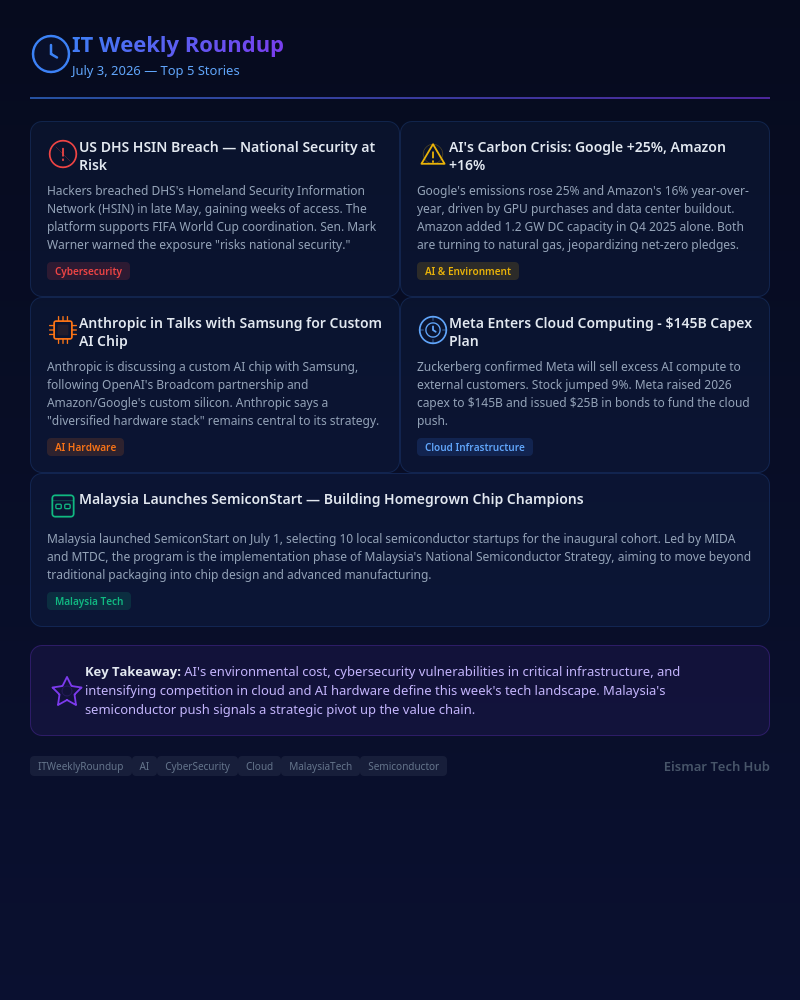
Infographic: IT Weekly Roundup — July 3, 2026

💬 0 Comments