The enterprise AI landscape has shifted gears. What started as experimental chatbots and isolated ML models has exploded into a full-blown agent race — with Microsoft, OpenAI, Meta, and SAP all betting that autonomous AI agents will redefine how businesses operate. If you manage enterprise IT, this is no longer a "watch and wait" moment. It's time to understand the players, the costs, and the infrastructure implications.
The Big Three Are Going All-In On Agents
Microsoft and KPMG just announced a global-scale deployment of Agent 365 and Copilot — bringing trusted, enterprise-grade AI agents into everything from audit workflows to supply chain management. This isn't a pilot program; it's production at scale. Meanwhile, OpenAI is leaning hard into enterprise contracts, moving beyond ChatGPT to offer custom agent frameworks for businesses that want private, fine-tuned models operating inside their own VPCs.
Meta isn't sitting out either. The company is positioning to convert billions of customer interactions across WhatsApp, Messenger, and Instagram into business AI agents — essentially offering every small-to-medium business a pre-trained customer service agent out of the box. The message is clear: agents are the new apps.
The Cost Reality Check: AI Sticker Shock
But here's the part that's making CFOs nervous. A recent Axios report highlights "AI sticker shock" hitting corporate America — with enterprise AI spending far outpacing initial budgets. The math is sobering:
| Cost Factor | Typical Range |
|---|---|
| LLM API calls (production) | $0.15–$3.00 per 1K queries |
| Fine-tuning a 70B model | $50K–$200K+ |
| Dedicated inference infra | $5K–$50K/month |
| AI agent orchestration layer | $10–$100 per agent/month |
IT leaders who jumped in without cost governance are now seeing six-figure monthly bills. The key takeaway: always cap API budgets, use caching layers, and right-size your model selection — you don't need GPT-4-class models for every internal Slack bot.
Infrastructure Implications: What Sysadmins Need to Prep For
Running enterprise AI agents isn't just about writing prompts — it's about infrastructure. Here's what's landing on sysadmins' plates:
- GPU and inference servers — Even with cloud APIs, latency-sensitive agents need edge inference. Expect to manage NVIDIA GPUs, or at least understand Kubernetes-based model serving with vLLM or TGI.
- Observability is non-negotiable — Agentic workflows are non-deterministic. Traditional monitoring (is the server up?) doesn't cut it. You need traceability for every LLM call, every tool invocation, every decision path. Tools like LangSmith, Weights & Biases, and OpenTelemetry-based tracing are becoming mandatory.
- Data governance — Snowflake's Horizon Catalog launch reflects a growing demand for AI governance. If your agents access internal databases, you need row-level security, audit trails, and PII redaction pipelines.
- Agent security — The OWASP Top 10 for LLM Applications is now essential reading. Prompt injection, data poisoning, and excessive agency are real threats.
Conclusion
Enterprise AI agents are no longer hype — they are being deployed in production at KPMG, SAP customers, and thousands of mid-market companies. For IT leaders and sysadmins, this means three things: govern your AI costs aggressively, invest in observability infrastructure, and start learning the agent stack today. The next 12 months will separate organisations that treat AI as a toy from those that run it as a utility.
The race is on. Make sure your infrastructure is ready.
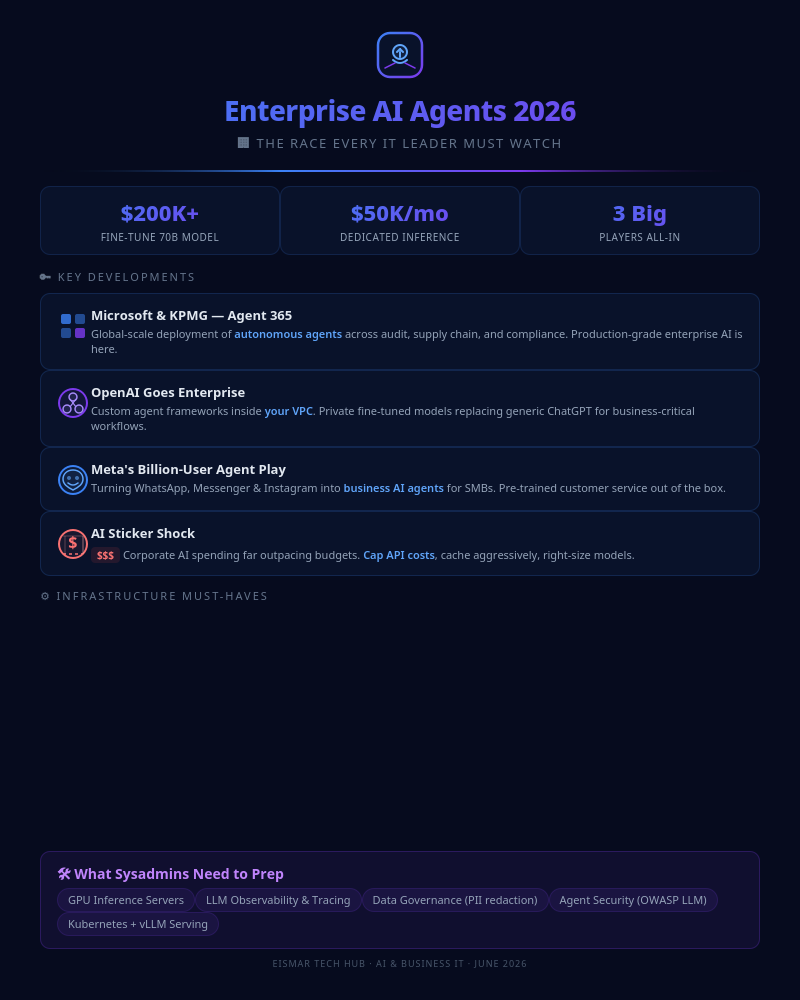
Infographic: Enterprise AI Agents 2026

💬 0 Comments